
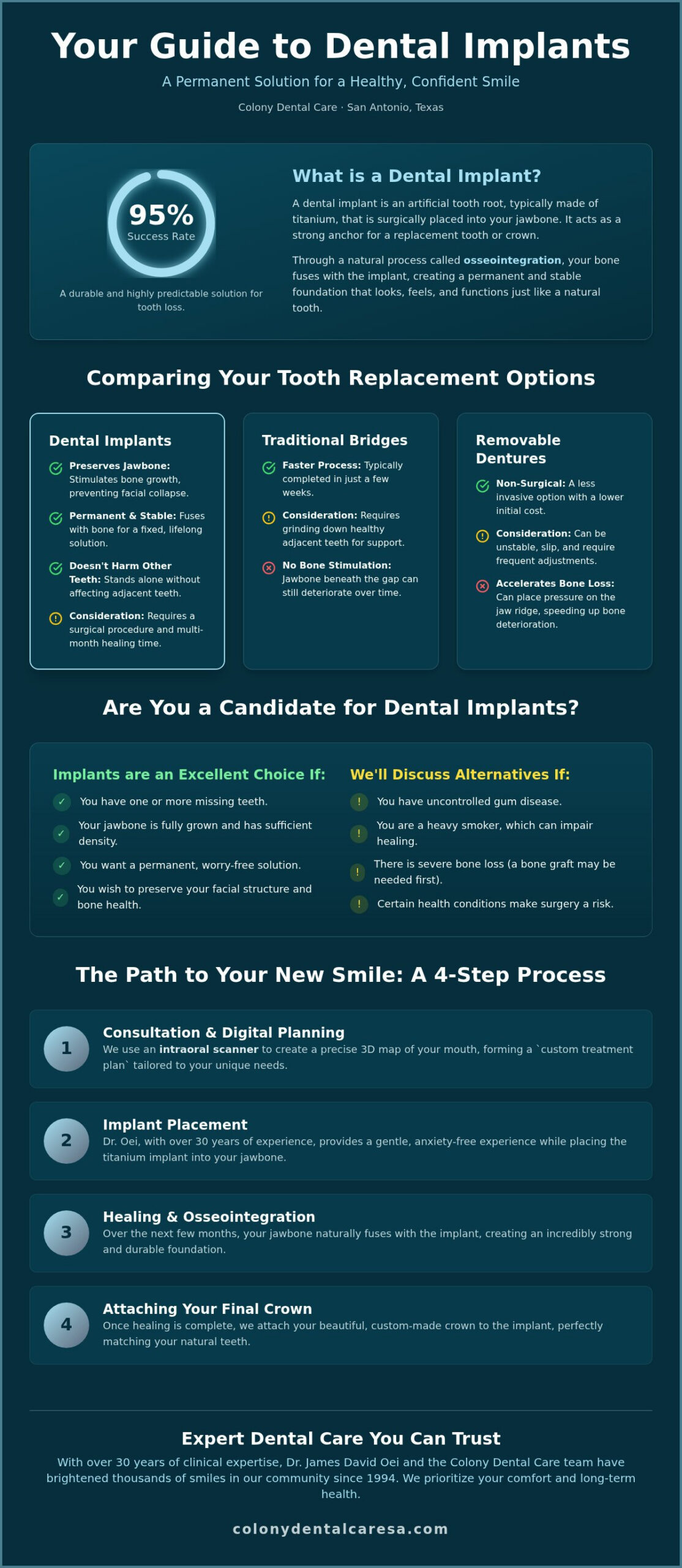
TL;DR: Dental implants provide a permanent, 95% success rate solution for tooth loss but require surgical healing and higher upfront costs than bridges or dentures.
- Success rates exceed 90 percent according to PMC2020, significantly outperforming the stability of removable dentures.
- Except when uncontrolled gum disease or heavy smoking prevents the titanium post from fusing to bone.
- Implants are best for patients seeking long-term jawbone preservation who can commit to a multi-month healing timeline.
- The article details a four-step process from digital scanning to final crown placement for predictable results.
Dental implants offer over a 95% success rate and prevent jawbone loss, but they require surgical healing time and higher upfront investments compared to traditional options. You can protect your smile and preserve your long-term health with these durable replacements. Our team provides compassionate, personalized care to help you make the right choice for your peace of mind.
Match bone density, bite, and goals before you pick a replacement
You match physical health and personal goals to the restorative option that fits your smile. Individual bone density often dictates which treatment works. A strong jaw foundation supports long-term success.
Typical situations we see:
- One missing tooth and healthy neighbors: a single implant fills the gap without reshaping adjacent teeth.
- Full-arch loss with enough bone: fake teeth on 4 posts (All‑on‑4 technique) rebuild the arch on a fixed foundation.
- Thin bone or active infection: bone filler (bone grafting material) or a bridge/denture path comes first so the site can support a post later.
Evaluating how teeth line up (bite alignment) shows whether a bridge or an implant serves you better. Your choice shapes how long the work lasts (maximum lifetime benefit). Missing bone needs bone filler before a new post can sit securely.
Since founding Colony Dental Care in 1994, Dr. James David Oei has treated patients like neighbors, not numbers. You can learn about gentle Services-dental Implants | Colony Dental Care San Antonio options that restore comfort.
Tip: Evaluate whether preserving neighboring teeth matters more to you than avoiding surgery before selecting your treatment path.
Dental implants give you a fused artificial root that stays put
A dental implant is an artificial root placed in your jaw to hold a replacement tooth securely in place.
It works as a sturdy anchor, giving a permanent foundation for your smile. Once installed, your jawbone attaches to it through bone fusing to the metal (osseointegration). Implants look and function like natural teeth.
Dental visits make many people nervous. If you dread the chair, modern gentle techniques support peace of mind during care. A study published in PMC2020 shows that implants have high long-term success rates above 90 percent. Our team at Colony Dental Care | Family Dentist in San Antonio focuses on personal warmth so you feel at home.
One user posted under "Reviews | The Colony, TX" at thecolonyfamilydental.com:
"I was very pleased with my entire experience at Dr. Rossen’s today. The entire staff were friendly and caring and very knowledgeable and made me very comfortable. I do appreciate them so much because I was so nervous when I arrived." (source)
Gentle care and supportive staff ease anxiety during complex procedures such as implant placement, so you stay comfortable through the journey.
Stability and bone protection versus healing time and upfront cost
Dental implants replace missing teeth permanently and give stronger stability than removable dentures or traditional bridges.
Many patients worry a dentist will push unnecessary or cosmetic work. We focus on your actual needs without adding extra treatments. Thirty-two years of practice have shaped a patient experience that blends clinical skill with a neighborly touch.
| Restorative Option | Key Benefit | Main Consideration |
|---|---|---|
| Dental Implants | Permanent support | Requires healthy jaw structure |
| Traditional Bridges | Replaces missing tooth | Alters neighboring teeth |
| Removable Dentures | Lower initial commitment | Needs regular adjustments |
Titanium posts stimulate the jawbone and slow natural bone reduction. Bone fusing to the metal helps keep facial structure strong. Implants behave as anchor roots, while a bridge leans on adjacent teeth as a temporary scaffold.
Comparing how long each option lasts clarifies what fits your smile and budget. Read Dental Implants in San Antonio: Your Complete Guide for 2026 for a fuller side-by-side. Implants suit people who want a fixed solution; dentures suit those who prefer a non-surgical path.
Uncontrolled gum disease or smoking can take implants off the table
A dentist will not recommend an implant if uncontrolled gum disease (periodontal disease) or heavy smoking threatens long-term bone integration.
From clinical care we observe that active infections routinely compromise bone fusing to the metal. Healthy tissue is required to anchor these restorations.
Overall well-being sets the safest path. Severe bone loss may need bone filler first. In some cases poor health makes surgery too risky.
You get transparent advice without soft-pedaling. We put your smile and peace of mind ahead of forcing complex procedures. To see how pathways fit different budgets, explore How Much Do Dental Implants Cost in San Antonio? 2026 Price.
Placing an implant into unhealthy tissue fails the same way a brick house fails on soft ground. A traditional bridge or denture is often the sounder medical choice. Honest care means listening carefully at each routine visit.
A contributor to the thecolonyfamilydental.com discussion "Reviews | The Colony, TX" shared:
"Unlike my dentist in Florida whom I hated, Dr. Rossen does not tell you that you need unnecessary work. My old dentist had told me I needed all my amalgam removed, wanted to do 6 crowns, and had a fascination with wanting everything white and pretty." (source)
Patients often feel steered into unwanted procedures; ethical care sticks to genuine clinical needs rather than high-cost add-ons and favors long-term health plus your preferences.
Four planned steps take you from scan to final crown
Your timeline follows a clear pathway meant to rebuild confidence and protect health.
Patients value knowing each phase in advance. Clear planning helps you prepare mentally and practically. As a member of the Academy of General Dentistry, American Dental Association, Texas Dental Association, and San Antonio District Dental Society, Dr. Oei guides this process with personalized care.
- Initial consultation: We evaluate oral health with digital mouth pictures (intraoral scanner) and design your tailored plan.
- Surgical placement: The dentist places the post into your jawbone.
- Natural healing: You wait for bone fusing to the metal. According to the CORDIS European Commission 2018 report, researchers developed advanced mechanical testing methods to assess implant stability during this crucial healing phase.
- Final placement: We secure your new custom crown to complete the smile.
Healing requires several months, so the schedule builds in that window. We prioritize comfort at each visit and welcome patients from across San Antonio, TX. A structured sequence supports predictable, lasting results.
Insurance limits, prep coverage, and monthly plans shape what you pay
Treatment cost depends on your individual needs, insurance coverage, and flexible monthly payment options. Each mouth presents a different situation.
Financial worry often delays needed dental work. Waiting usually raises total care costs as conditions worsen, so an early assessment protects both health and budget.
Standard insurance policies frequently pay for just two dental checkups a year, which leaves extensive restorative care uncertain. Staff work with many dental insurance plans and help maximize benefits. Basic policies rarely cover the full procedure, yet your plan may still help with preparatory care or final restorations such as crowns.
You can pay upfront or spread the balance across manageable monthly installments through third-party financing, which turns the total into a predictable monthly figure. Structured plans fit patients who want fixed costs without cutting quality.
Request a personalized quote for your specific care plan.
Tip: Check whether your insurance classifies implant crowns under major restorative care to maximize annual benefits.
Frequently asked questions
What are the downsides of dental implants?
The main downsides are surgical healing times and higher initial costs compared to bridges or dentures. Bone fusing to the metal takes several months to complete. Advanced gum disease or insufficient jawbone can also cause delays. Staff work with many dental insurance plans and help maximize benefits so treatments stay manageable.
What does no one tell you about dental implants?
You must give them the same routine care you give natural teeth. Trapped food can still spark infections in the surrounding gums without thorough brushing. Overall health strongly influences how well the jaw heals. Steady home care supports peace of mind for decades.
What is the fail rate of dental implants?
Dental implants carry a very low failure rate of roughly five percent nationwide. Success depends on proper oral hygiene, strong bone density, and routine checkups. Smoking or active gum infections can raise complication risk. Thirty-two years of focused patient experience back the long-term support you receive here.
Why would a dentist not recommend an implant?
A dentist might suggest other options if your jawbone is too thin or if active medical conditions slow natural healing. Severe gum disease must be fully resolved before an implant post is placed. Dr. Oei is a member of the Academy of General Dentistry, American Dental Association, Texas Dental Association, and San Antonio District Dental Society, and he tailors guidance to your needs. Alternatives may fit better when surgery is not ideal.
Do dental implants look like natural teeth?
Yes, modern dental implants match the color, shape, and translucency of your original teeth. Custom porcelain crowns blend into the existing smile. They stay fixed so you can chew and speak with confidence. Other people rarely notice a replacement tooth.
Next Steps for Your Smile
Weighing stability, bone protection, healing time, and cost brings you back to the same decision you started with: whether an implant’s durability fits your health, timeline, and budget.
In 2026, bone fusing to the metal remains a proven route for restoring missing teeth. Clear facts on how long restorations last support calm choices. Knowing both sides lets you decide with confidence.
The team offers restorative care backed by over three decades of community service in San Antonio, Texas. Professional memberships stay current, and dental insurance is accepted to keep quality care within reach. Contact us to schedule your personal consultation.

