
The usual Spanish word for a group of coworkers means “team.” You can describe a Spanish-speaking team as kind, attentive, and professional. These straightforward English adjectives help you explain the qualities you value in the people supporting your care.
It’s natural to want clear, comfortable communication at a dental office. Knowing how to refer to coworkers as a group, and which words describe them, can help you express what matters during a visit.
Here, you’ll learn how to talk about a team in Spanish and describe its members naturally. You’ll also see how kindness, attentiveness, and professionalism can make communication feel more welcoming during a dental visit.
Key Takeaways
- Learn the common Spanish term for a team and how to choose adjectives that describe its members naturally.
- Explore practical ways to assess language skills and understand why conversational ability may differ from interpretation experience.
- Find out how plain language, respectful clarification, and attention to regional word choices can support clearer communication.
- See how bilingual learning materials and ongoing practice can help a workplace build stronger language skills over time.
How can I verify a team’s Spanish proficiency and credentials?
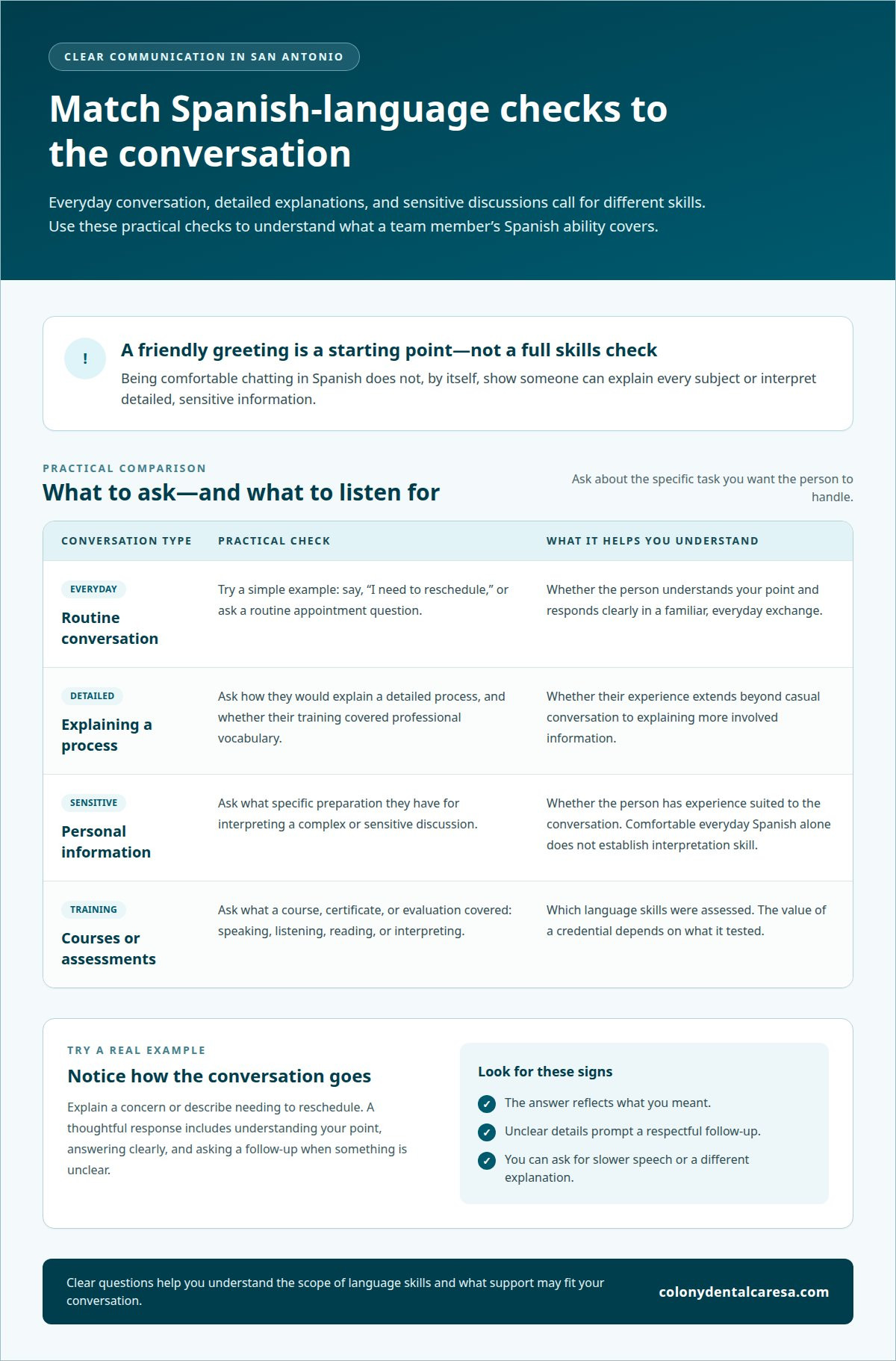
Start by asking what kinds of conversations each team member can handle in Spanish. Everyday conversation, discussing a detailed process, and explaining sensitive information call for different skills. In San Antonio, a friendly greeting may show familiarity with Spanish, but it doesn’t establish that someone can clearly explain every subject. Ask about a practical example, such as discussing an appointment or answering a routine question.
You can also ask about relevant training or language assessments. A course, certificate, or evaluation may offer insight into someone’s background, but its value depends on what it assessed. Ask whether it covered speaking, listening, reading, or interpreting. Someone who chats comfortably may still need specific preparation for detailed or sensitive conversations. Asking about the task helps clarify the scope of their language skills.
Pay attention to how the conversation goes, too. Try a simple example, such as saying you need to reschedule, and listen to the response. Does the person understand, answer clearly, and ask a follow-up if something is unclear? A thoughtful clarification is more helpful than a quick reply that misses your point.
Use these practical checks when discussing language ability and credentials:
- Ask about the task: Can the person greet you, explain routine information, or interpret a complex discussion?
- Ask what training covered: Did it focus on conversation, professional vocabulary, or interpretation?
- Try a real example: Explain a concern and see whether the response reflects what you meant.
Finally, explain what helps you communicate. You might prefer slower speech or want an unfamiliar term explained in another way. Specific questions can help you understand how the team can support each conversation.
What are the risks of relying on bilingual team members for interpretation?
Speaking two languages doesn’t automatically make someone a skilled interpreter. A bilingual coworker may understand everyday conversation but lack experience conveying complex details accurately. For example, they might summarize a long explanation instead of preserving each point. That could leave you with an incomplete understanding of instructions, choices, or next steps. Communication can be more challenging when a conversation includes unfamiliar terms, strong emotions, or several questions at once.
Accuracy can also suffer when an employee is interpreting while handling other duties. A receptionist answering the phone and greeting visitors while interpreting may miss a detail. Even a small change in wording can alter the meaning. If you say, “The pain started after lunch,” but the employee hears, “The pain gets worse after lunch,” the timeline changes. Clear communication means conveying your words, not guessing at what you meant.
Privacy and comfort matter, too. You may feel uneasy discussing personal information with a coworker you know socially or see outside work. A relative or colleague might also soften your words, filter information, or answer for you. In a dental conversation, you should be able to explain what concerns you and hear the response directly. Your preferences deserve to be respected.
Watch for these signs that a conversation needs a pause:
- Details keep changing: A date, symptom, or instruction sounds different each time it is repeated.
- Someone answers for you: You haven’t had the chance to finish explaining your concern.
- Key terms stay unclear: You still can’t describe the next step in your own words.
If confusion arises, ask for the message to be repeated in shorter parts, then restate what you understood. For example, summarize the next appointment step and invite a correction. This simple pause can reveal a missed detail before you leave. If a routine visit is your next step, explore dental cleanings and exams and consider what questions you want answered.
How can a team communicate effectively with Spanish-speaking clients across different dialects?
Spanish speakers may use different words, accents, and expressions, so clear communication starts with listening. Ask which wording feels familiar and use it consistently. A common word for “team” may also refer to equipment, so context can clarify its meaning. Don’t assume one person’s preferred phrasing works for everyone. In San Antonio, using the words someone prefers helps keep the conversation respectful and clear.
Choose plain, direct language instead of idioms, slang, or regional jokes. A phrase that sounds friendly to one person may confuse another. For instance, say, “Please arrive before your appointment,” rather than using a local expression about being on time. If a term is unfamiliar, explain it with a short example. In a dental conversation, describe what a cleaning involves using familiar, everyday language.
Use a few practical habits to keep the meaning clear:
- Ask about preferred terms: Invite the person to tell you which word they use for an item or step.
- Explain unfamiliar language: Replace a technical term with a familiar phrase and a concrete example.
- Confirm the main point: Ask the person to describe the next step in their own words.
Keep the conversation unhurried. Give the other person time to finish, and don’t interrupt to correct an accent or word choice. If you hear a phrase differently than expected, ask respectfully, “Could you tell me what you mean by that?” Then repeat the agreed meaning in simple language. For example, clarify whether someone means a group of coworkers or a piece of equipment before moving on. These small steps support understanding while respecting each person’s natural way of speaking.
AI training for employees who are less comfortable with technology can begin on a phone, using examples from their own jobs.
What steps can an employer take to build a Spanish-speaking team
Building a Spanish-speaking team starts with understanding the communication needs of each role. A front-desk employee may answer appointment questions, while a supervisor may explain workplace procedures. List the conversations employees handle and the language skills each one requires. This keeps training focused on daily tasks instead of broad goals. In a San Antonio workplace, that might mean practicing a greeting, explaining a schedule change, or giving directions to a meeting room.
Next, offer language learning that matches those tasks. Pair short lessons with role-play, such as welcoming a Spanish-speaking customer or clarifying a delivery time. Give employees room to practice useful vocabulary and ask questions. A Spanish-speaking team can grow stronger when learning continues beyond a single presentation and employees can revisit useful phrases during everyday work.
Provide bilingual materials staff can revisit. A guide in English and Spanish can help employees review instructions after a session. Keep both versions aligned and use plain language in each. For example, a safety reminder should state the action clearly rather than rely on a local expression or unexplained abbreviation.
Support shared learning across the workplace:
- Set role-based goals: Define the conversations each employee needs to manage, such as greeting visitors or explaining a work process.
- Practice real situations: Use brief role-play for routine exchanges, then discuss what sounded clear or confusing.
- Share learning materials: Provide training resources in both English and Spanish for later review.
- Invite continued practice: Make space for employees to ask questions and learn from everyday interactions.
Finally, treat language growth as a team effort. A coworker can share a useful phrase, while others suggest clearer alternatives. Keep feedback respectful and focused on understanding, not accent or perfection. After a practice conversation, ask whether the main instruction was clear and what wording might help. These habits help a Spanish-speaking team build confidence through communication shaped around its daily needs.
Colony Dental Care: Dental Cleanings and Exams
Colony Dental Care provides dental exams and cleanings to support your oral health and give you a chance to discuss questions about your care. A visit can be a useful next step if you’re due for a checkup or want to talk through a dental concern in a comfortable setting.
If an exam identifies a cavity, a tooth-colored filling may help restore the affected tooth. Invisalign® Clear Aligners can address certain alignment goals, and tooth extractions are available when a tooth needs to be removed. Your needs and questions can guide a discussion about appropriate care.
Clear communication can help you feel informed about each step. Contact Colony Dental Care to discuss your dental care needs.
Make your next dental conversation feel clear
Good communication is about more than choosing the right words. With a Spanish-speaking team, you can share what matters, understand your options, and take part in decisions about your care. Tell the team what helps you feel comfortable and which questions you’d like answered to make your visit more personal.
When you’re ready to focus on your oral health, Colony Dental Care provides dental exams and cleanings, tooth-colored fillings, and Invisalign® Clear Aligners. The team provides care in Spanish, so you can discuss these services and your dental goals in a familiar language. Take the next step at a pace that feels right for you.
Contact Colony Dental Care to discuss your dental care. You deserve to feel welcome, heard, and confident as you move forward.
Frequently Asked Questions
What does “a Spanish-speaking team” mean?
A Spanish-speaking team means coworkers who can communicate with you in Spanish as part of their work. Their language skills may vary by task, such as greeting visitors, discussing schedules, or explaining a service. At a dental office, you might value speaking Spanish when describing your reason for a visit or asking what to expect. The phrase describes language support, not a particular job title.
How do I find dental care near me in Spanish?
If you’re looking for dental care in San Antonio, Colony Dental Care serves the local community and provides care in Spanish. Consider whether the practice’s location and services fit your needs. You can also prepare a short list of concerns, such as tooth sensitivity or a question about an upcoming appointment, to guide your first conversation.
What should I ask about Spanish-language support?
Ask which parts of the visit can be discussed in Spanish and whether written information is available in that language. You might also ask how staff explain an unfamiliar dental term or help you review next steps. For example, if you receive care instructions, ask for a plain-language explanation you can recall later. These questions clarify how communication support fits your visit.
What are the benefits of communicating with dental staff in Spanish?
Speaking with a Spanish-speaking team can make it easier to describe your concerns and ask follow-up questions in familiar words. You may find it simpler to explain what you hope to address, whether it’s a routine checkup or a specific tooth concern. Clear, comfortable conversation can help you stay involved as you discuss your care and decide which questions matter most.

