
You notice a new bump along your gumline and wonder what it means. “Raised” describes its lifted appearance, not its cause. If you’re in San Antonio, note where the bump is and when you first noticed it so you can describe the change during a dental visit.
It’s understandable to feel concerned when your gums change, especially if the area is tender or uncomfortable. This guide explains how “raised” is used in current English, how it relates to “raise,” and how its other forms work in everyday sentences. It also explains why a word describing appearance cannot, by itself, explain a change in your gums.
Key Takeaways
- Understand how a gum bump’s appearance differs from identifying its cause.
- Learn how the past-tense form of “raise” works in everyday English.
- See how “raise” takes an object when describing upward movement, and how its other forms fit into sentences.
- Know how a dental exam can help assess a change in your gums and guide the next step in care.
Example sentences and current usage
Raised can describe an increase, a topic introduced for discussion, or a feature that stands above a surface. The surrounding words make the intended meaning clear. For example, “The board raised a concern” introduces an issue, while “raised lettering” describes text that projects from a page. Dictionary definitions and example sentences can help distinguish these uses.
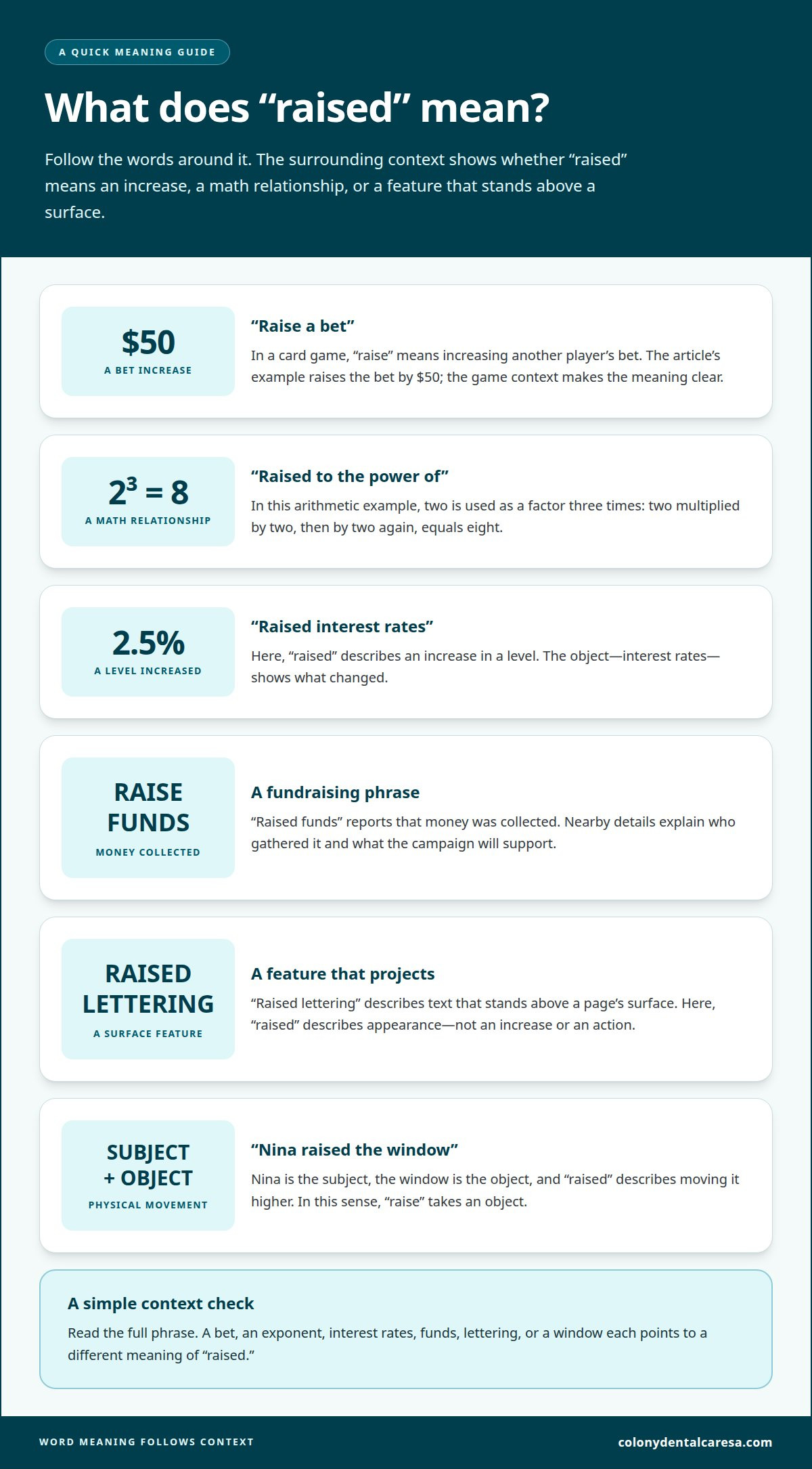
In card games, “raise” can mean increasing another player’s bet. A dictionary example describes raising that bet by $50. The amount shows the size of the increase, while the game setting supplies the specialized meaning. This usage appears in conversation about poker and other betting games. Outside that setting, readers may understand “raise a bet” as increasing the wager, but the surrounding game context removes doubt.
In mathematics, “raised to the power of” describes an exponent. For example, “Eight is two raised to the power of three.” The three indicates that two is used as a factor three times: two multiplied by two, then by two again, equals eight. This precise mathematical meaning differs from the everyday sense of moving an object upward.
Fundraising offers another familiar use. The phrase “raise funds” appears in school announcements, nonprofit updates, and community appeals. A San Antonio reader might see it in a local organization’s event notice. Here, “raised” reports that money was collected, while the surrounding details explain the campaign’s purpose.
Writers use the word in varied ways, but an invented example should not be mistaken for a published quotation. Consider this original sentence: “A pale moon hung above the San Antonio rooftops, and a question rose in Elena’s mind.” The verb “rose” differs from “raised a question.” The first describes a thought appearing on its own; the second usually means someone deliberately introduced a topic.
Another original line might read, “The detective raised an eyebrow at the final clue.” This familiar expression suggests surprise or doubt without naming those feelings directly. In a story set near the Alamo, a writer might use the gesture to show a character reacting to a surprising discovery. Ordinary gestures and phrases can add emotional color to fictional dialogue.
Some meanings depend on the noun that follows. “Raised fabric” describes cloth with a nap, a surface of short fibers. “Raised dough” means dough leavened with yeast rather than baking powder or baking soda. A recipe or clothing description usually makes the meaning clear. In “The jacket has raised fabric along its collar,” the context points to texture, not an action.
To interpret an unfamiliar example, read the full sentence and identify its subject area. A card-game discussion, math lesson, fundraising appeal, or recipe offers different clues. Compare the phrase with a dictionary definition and its examples. For a literary passage, read the surrounding sentences too. Context may show whether the writer means a wager, an exponent, a campaign, a texture, or an emotional gesture.
The arithmetic wording is especially compact: in the dictionary’s arithmetic example, 8 is 2 raised to the power 3. Here, “raised” belongs to a mathematical expression, and the exponent marks the relation between the numbers. A reader can recognize this sense by the phrase “to the power,” rather than by imagining an object lifted. That distinction keeps the mathematical reading clear, even though the verb also appears in descriptions of movement or change.
In this use, the phrase describes gathering contributions, and the money is connected with a purpose. It is an account of what was collected, not a claim that the amount itself was physically lifted. Nearby details can clarify who gathered the money and what it will support. Together, these patterns show how a familiar verb takes its meaning from its construction: “raised to the power” marks an arithmetic relationship, while “raised funds” describes collecting money. Keeping the full phrase in view helps readers distinguish these senses without relying on the verb alone.
Moving something to a higher position
To raise something is to move it from a lower level to a higher one. In “Nina raised the window,” Nina is the subject, the window is the object, and “raised” describes the completed action. The sentence says what moved and who moved it. The same pattern works in “lifted the box” or “raised the flag.” In this meaning, “raise” is transitive and takes an object.
An elevated object is placed above its usual or surrounding level. “The museum displayed the sculpture on an elevated platform” tells you where the sculpture sits. “Elevated” describes the platform’s higher position. In “The road climbs to an elevated crossing,” it describes the crossing relative to the road. The adjective provides a spatial clue, while the noun identifies what is higher.
Position means the place or level where a person or thing is located. “The vase holds a central position on the table” describes location, not upward movement. By contrast, “Maya raised the vase onto the shelf” describes an action. Ask whether the sentence names a location or movement: “The book is in a higher position” describes location, while “Leo raised the book” reports movement.
English uses raise for physical movement and for increases in amounts or levels. “The gardener raised the planter above the wet ground” describes a physical lift. “The European Central Bank raised interest rates to 2.5% in September 2026” uses the verb for an increase. The object, interest rates, identifies what changed. In both sentences, the grammatical pattern stays clear: a subject acts on an object.
In practical writing, choose the verb that shows how an object moves. “She raised her hand” describes upward movement. “He lifted the suitcase onto the bench” emphasizes carrying it upward. “They elevated the display” sounds more formal than “they raised the display.” Each can convey height, but the nouns and setting help determine the most natural wording.
Directions often use “raise” for an upward adjustment. “Raise the blinds to let daylight enter” tells someone to move them higher. “Raise the microphone before the speaker begins” gives a clear instruction and purpose. For a temporary action, state the sequence: “Raise the lid, then place the bowl inside.” This makes the instruction easier to follow.
“Raise” also describes nonphysical increases. “The school raised funds for new books” means it collected money. “The editor raised a question about the final paragraph” means the editor introduced an issue. “The announcement raised hopes” describes its effect on people’s expectations. Each example has an object after the verb, but the objects are funds, a question, and hopes, not movable items.
Use this editing check: find the subject and object, then decide whether the meaning is physical or figurative. In “The crew raised the curtain,” the crew acts on a physical object. In “The news raised concern,” the news prompts an emotional response. If you mean “move something upward” but no object follows, revise the sentence. For example, change “The worker raised” to “The worker raised the platform.”
For a clear description, pair an action with a destination or result. “Place the box on the upper shelf” names the destination. “Raise the box until it reaches the shelf” emphasizes movement. An elevated seat is already higher; raising a seat changes its level. These distinctions help readers picture a scene, follow directions, and tell whether a sentence describes a position, action, or increase.
Raised can also describe a surface or design that projects from a background, rather than an object simply placed higher. The adjective raised was first used circa 1550 in the meaning of something done in relief. In this use, raised lettering or decoration stands out from the surface around it; the word describes its form, not an upward movement taking place now. Context distinguishes a raised pattern from an item that someone raised.
An increase can also be described by comparing a rate with its earlier level. The Reserve Bank of Australia’s 4.85% interest rate was the highest since 2008. Here, highest indicates a relative level, while raised describes the act of increasing the rate. A sentence can clarify whether it reports a current level or the change that brought it about.
Colony Dental Care
If you notice a gum bump or a change, Colony Dental Care in San Antonio can help with a clear next step. A Dental Cleaning and Exam gives the dental team an opportunity to assess your oral health and discuss what you’ve noticed. The bump’s position alone doesn’t explain its cause, so mention when you first saw it and whether it has changed or feels uncomfortable.
If you also have a damaged tooth or another dental concern, Colony Dental Care provides Tooth-Colored Fillings, Tooth Extractions, and Emergency Dental Care. Your needs and the exam findings help guide the appropriate care. The team can explain the next steps in straightforward language, with your comfort in mind.
Contact Colony Dental Care in San Antonio to discuss a gum change or arrange an exam.
Choose a Clear Next Step for Your Gum Health
A change in your gums can be easier to discuss when you can describe where it is and how it has changed. If you notice a new or changing bump, share those details during a dental visit. “Raised” describes its appearance, but an examination can assess the tissue and help identify an appropriate next step.
Colony Dental Care provides Dental Cleanings and Exams, as well as Tooth-Colored Fillings when a tooth needs restorative care. Share your concerns and ask for a clear explanation of the care being considered. Understanding what you’ve noticed is a practical first step in deciding what to do next.
If you’d like to talk with our team about a change in your gums, contact Colony Dental Care. We’re here to help you take that next step with care and clarity.
Frequently Asked Questions
What are common uses of the word “raised”?
“Raised” commonly describes lifting something, increasing an amount, or introducing a topic. “She raised her voice” describes speaking more loudly, while “He raised the issue at the meeting” means he brought it up for discussion. As an adjective, “raised” can describe a feature above a surface, such as lettering on a sign. The surrounding words clarify the meaning.

