San Antonio’s healthcare education story is bigger than a campus map. UTSA and UT Health San Antonio now form one unified university, with more than 300 academic programs and six health professional schools. If you’re exploring where future health professionals study and train in San Antonio at UTSA and UT Health San Antonio, the answer includes both academic campuses and patient-care locations.
It’s natural to want a clear picture of how education connects with care in your community. This guide explains the university’s academic and health professional programs, where its campuses are located, and how its patient-care sites fit into San Antonio. You’ll get an overview of the local landscape, whether you’re considering a program, looking for care, or learning more about the institutions shaping health and education here.
Key Takeaways
- See how San Antonio’s university campuses and patient-care locations serve different purposes, and what to look for when exploring each.
- Get a clearer sense of the health-focused study paths available and how academic training connects with care in the community.
- Learn how local dental care can support everyday needs, from exams and cleanings to Invisalign clear aligners.
- Understand which details can help you decide where to learn more about programs, campuses, or dental care close to home.
Texas antonio
San Antonio’s higher education landscape now centers on one unified institution. The University of Texas System Board of Regents authorized integrating UTSA and UT Health San Antonio to create UT San Antonio by 2025. That change brings academic programs, health professional education, research, and patient care under one university identity. You may still encounter the familiar UTSA and UT Health San Antonio names while learning about the institution.
The scale is substantial. UT San Antonio has more than 44,000 students and offers more than 300 academic programs. It is the third-largest public research university in Texas. Those figures help explain why the university’s footprint matters beyond a single campus or department. For prospective students, the program count signals choices across many fields. For San Antonio residents, the institution’s reach includes research and health education alongside its academic offerings.
San Antonio itself is a major part of this story. It is the seventh-largest city in the United States, and the surrounding region is growing. The city added nearly 22,000 residents between July 2022 and July 2023, more than any other U.S. city during that period. South Texas is home to 5.5 million people and is projected to reach 6.1 million by 2040. This regional context helps explain why local education and patient-care locations matter to residents.
For a clearer picture, separate the university’s presence into three parts:
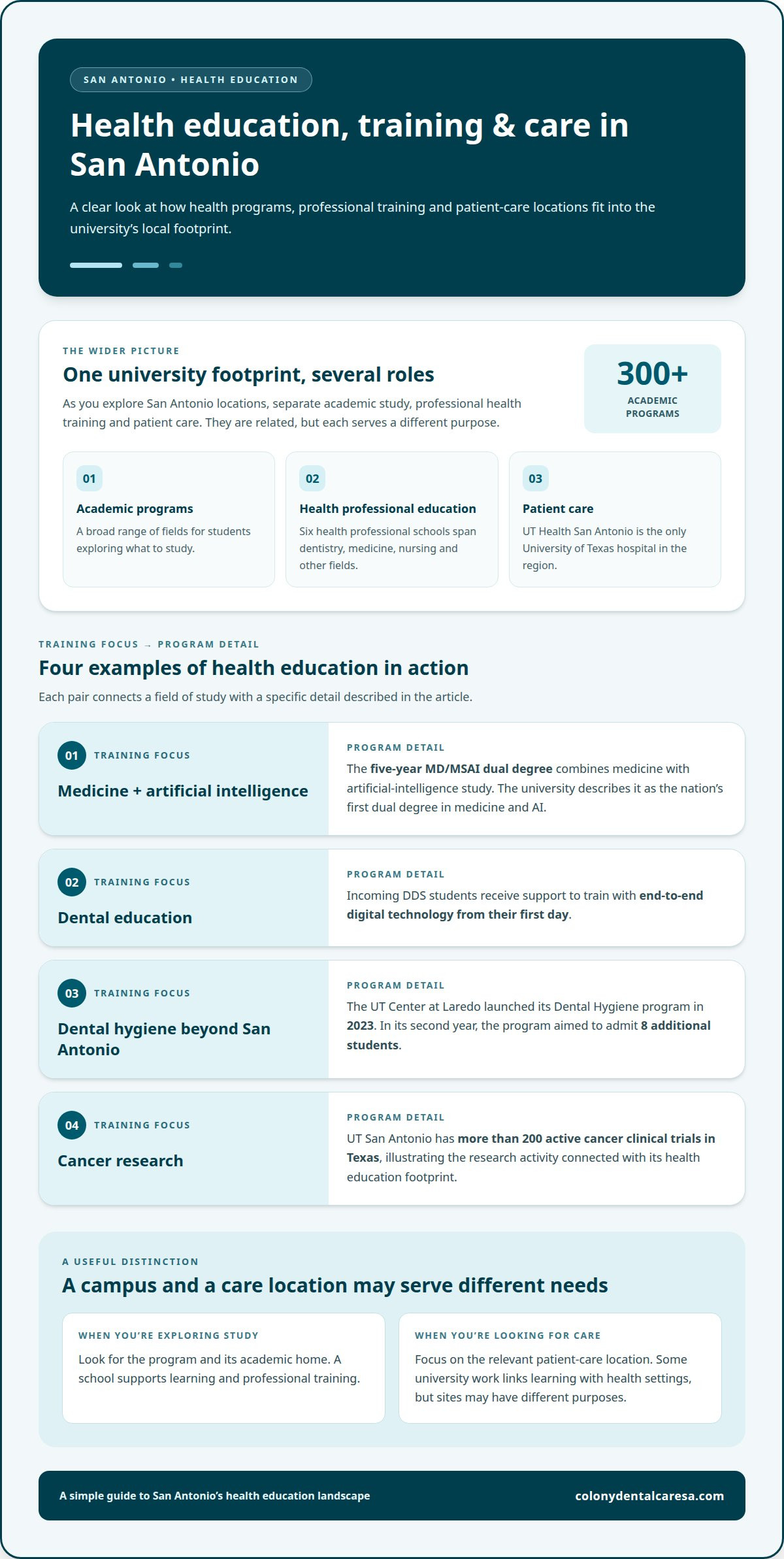
- Academic programs: UT San Antonio offers more than 300 options for students exploring fields of study.
- Health professional education: The institution has six health professional schools.
- Patient care: UT Health San Antonio is the only University of Texas hospital in the region.
This distinction helps you understand whether a university location primarily serves as an academic campus, a health training site, or a place for patient care. Campuses and care locations are related, but they serve different needs. If you’re exploring where to study, look at the program and its academic home. If you’re seeking care, focus on the relevant patient-care location.
Research is another part of UT San Antonio’s regional role. The combined institution was projected to become Texas’s third-largest research university, with annual research expenditures nearing $470 million. It was also described as encompassing six federally funded research and development centers. These details point to a university with both educational and research activity, rather than a campus focused only on classroom instruction.
One example is the Alzheimer’s Disease Research Center at UT San Antonio, Texas’s first National Institute on Aging-designated Alzheimer’s Disease Research Center. The designation gives the university a distinct role in aging-related research in Texas. It also illustrates how specialized research can connect with broader health priorities affecting families and communities.
The university’s San Antonio footprint continues to develop. A news item dated April 6, 2026, announced the opening of UT San Antonio’s tech-industry career-engaged learning hub. Another, dated March 29, 2026, described the university establishing a presence at One Riverwalk Place. These developments add to the city’s mix of learning and professional activity, while showing that the university’s presence extends beyond a single type of location.
When you read about UTSA and UT Health San Antonio, the names may refer to the institution’s familiar roots as well as its unified identity. UT San Antonio brings together academic breadth, health professional training, research, and regional patient care. Understanding these roles makes it easier to interpret campus information and distinguish educational sites from care locations across San Antonio.
Their shared setting remains significant: UT San Antonio and its Health Science Center are located in the seventh-largest city in the United States. Together, UTSA and UT Health San Antonio educate a total student population of 38,000, giving the region a substantial base of learners across university and health-science education.
Health care
UT San Antonio connects health professional education with research and patient care. The key distinction is each location’s purpose: a school supports learning, while a patient-care site provides clinical services. Some university work connects both, such as training that places students in health settings. The university’s health programs span dentistry, medicine, nursing, and other professional fields.
Dentistry offers a direct example of how training is changing. This detail points to an educational environment where digital tools are part of dental training early. It does not mean every patient-care location uses the same tools or offers the same services.
Health education also crosses disciplines. UT San Antonio and UT Health San Antonio offer a five-year MD/MSAI dual degree program that combines medicine with artificial intelligence. The university describes it as the nation’s first dual degree in medicine and AI. This path may interest students who want to study clinical care alongside computing and data-focused applications. Its structure differs from a standard single-field degree.
Program details can help you understand the university’s wider health footprint:
- Medicine and AI: The MD/MSAI program brings medical and artificial-intelligence study together over five years.
- Dental education: Incoming DDS students receive support for training with end-to-end digital technology from their first day.
- Dental hygiene: The UT Center at Laredo launched its Dental Hygiene program in 2023.
- Clinical research: UT San Antonio has more than 200 active cancer clinical trials in Texas.
The dental hygiene example also shows how health education reaches beyond San Antonio. In its second year, the UT Center at Laredo program aimed to admit eight additional students. That is a specific program goal, not a description of enrollment across the university. For readers comparing locations, the distinction matters: a health program may be based at a center outside San Antonio, while other university education and patient care are connected with the city.
Research is another part of the health-care picture. UT San Antonio is one of four NCI-designated cancer centers in Texas. The university also has more than 200 active cancer clinical trials in Texas. These figures describe research and clinical-trial activity, not a promise that every treatment or trial is offered at every patient-care site. A location’s role depends on the service or research program involved.
UT Health San Antonio has more than 800 physicians who are board-certified in more than 100 specialties. That breadth gives the institution a substantial clinical presence, while its schools prepare health professionals. If you’re looking for care, identify the specific service you need and the patient-care location associated with it. If you’re exploring education, start with the school and program, then distinguish its teaching location from its clinical training settings.
A clinician educated and trained in San Antonio through UTSA and UT Health San Antonio may have a local academic connection, but that phrase alone doesn’t identify their degree, specialty, or current practice location. These are separate details. Knowing the difference helps you read professional biographies accurately and understand how university training, research, and patient care fit together across the region.
That research presence also has a regional-care dimension: a news item about UT Health San Antonio bringing advanced cancer care closer to South Texas is dated May 20, 2026. The date identifies the item, while its subject points to a regional focus; it does not, by itself, measure access or outcomes. UT Health San Antonio ranks in the top 3% globally for National Institutes of Health funding, a figure that adds context about research funding without indicating what care is available at any particular location. Its status as 1 of 4 NCI-designated cancer centers in Texas likewise gives a statewide frame for the institution’s cancer work, rather than a guide to an individual patient’s treatment.
Laboratory work is another link between health research and clinical decisions: medical laboratory scientists’ work informs up to 70% of all major decisions. The figure signals why laboratory roles matter within healthcare, but it should not be read as a claim that every decision relies on the same test or process. The workforce context is also substantial: more than half of the 20 fastest-growing occupations in the United States are related to healthcare, and 40% of jobs added in the United States were in the healthcare industry, based on March 2026 data. These broad employment measures can help prospective students weigh the reach of healthcare careers alongside the particular educational and research opportunities described here.
Colony Dental Care
Colony Dental Care can help you move from learning about San Antonio’s health education landscape to finding local dental care. For ongoing oral health support, Dental Cleanings and Exams provide a starting point to discuss your teeth and gums. For a specific concern, care may include Tooth-Colored Fillings, Invisalign Clear Aligners, or Tooth Extractions, depending on your needs.
A dentist’s university education and a practice’s services are separate details. When comparing professional backgrounds, look for the dentist’s stated education and training alongside the care you need. This helps you make an informed choice without assuming every San Antonio dentist attended the same program.
If you have questions about your dental care, contact Colony Dental Care to discuss your needs.
Choose Care That Fits Your Next Step
A professional’s education can help you understand their background, but your goals should guide your care conversation. A dentist educated at UTSA and trained in San Antonio through UT Health San Antonio may have local academic ties. Your next step is to discuss what you want help with, your comfort, and the care that fits your needs. A credential offers useful context, while clear communication helps you make decisions about your oral health.
At Colony Dental Care, you can discuss preventive care through Dental Cleanings and Exams, repair options such as Tooth-Colored Fillings, or Invisalign Clear Aligners if you’re considering changes to your smile. Sharing what matters to you makes the conversation relevant, whether you have a specific concern or want guidance on ongoing care. You deserve clear explanations and the opportunity to ask questions.
When you’re ready to talk about your dental needs, contact Colony Dental Care. Start with the questions that matter most to you, and take your next step with confidence.
Frequently Asked Questions
What does “trained in San Antonio (UTSA & UT Health)” refer to?
It describes a San Antonio connection to UTSA and UT Health San Antonio in a dentist’s background. The parenthetical names institutions, not a formal degree title. If you see this wording in a biography, read it as a brief description of local ties, rather than the name of a specific credential.