If your dentist has mentioned periodontal deep cleaning, you may be wondering how it differs from a routine cleaning, what the visit involves, and whether insurance may help with the cost. A recommendation is a reason to get clear information about your gum health, not a reason to feel alarmed. This guide to periodontal deep cleaning San Antonio care explains what to expect and what to ask.
A routine cleaning removes buildup from accessible tooth surfaces and around the gumline. Deep cleaning addresses plaque and tartar beneath the gumline when an evaluation shows signs of gum disease. At Colony Dental Care, we’ve served the San Antonio community for more than 30 years with personalized, gentle care. Your dentist can explain the findings and discuss care that fits your needs.
Read on to learn why deep cleaning may be recommended, how it differs from other gum treatments, and how to prepare for a visit. We’ll also cover insurance and payment options so you can plan with more clarity.
Key Takeaways
- Bleeding or swollen gums are reasons to schedule an evaluation, not proof on their own that you need deep cleaning.
- For periodontal deep cleaning San Antonio care, your dentist assesses your gums, explains the findings, and discusses a plan with you.
- Routine cleaning, scaling and root planing, and laser gum treatment address different needs. Ask how each relates to your evaluation.
- Before treatment, share your medications, health concerns, and dental anxiety. Ask about comfort measures and follow-up.
- Colony Dental Care provides periodontal disease treatment, including laser gum treatment and Arestin®, and accepts many dental insurance plans.
When might periodontal deep cleaning in San Antonio be recommended?
A deep-cleaning recommendation should follow an evaluation, not one symptom or a routine schedule alone. Your dentist looks for buildup beneath the gumline and signs that your gums need periodontal care. Ask which areas are affected, what the exam showed, and why the recommended treatment fits those findings.
Scaling and root planing is a deep-cleaning treatment that removes plaque and hardened tartar from beneath the gumline and smooths the tooth roots. This addresses buildup in areas a routine cleaning may not reach. For an overview of the procedure, see What is scaling and root planing?
In San Antonio, periodontal deep cleaning is one possible form of care when an evaluation points to gum concerns that need more than preventive cleaning. A clear recommendation should explain which areas need attention and why. You deserve to understand the findings and discuss your options before treatment begins.
How is deep cleaning different from a routine dental cleaning?
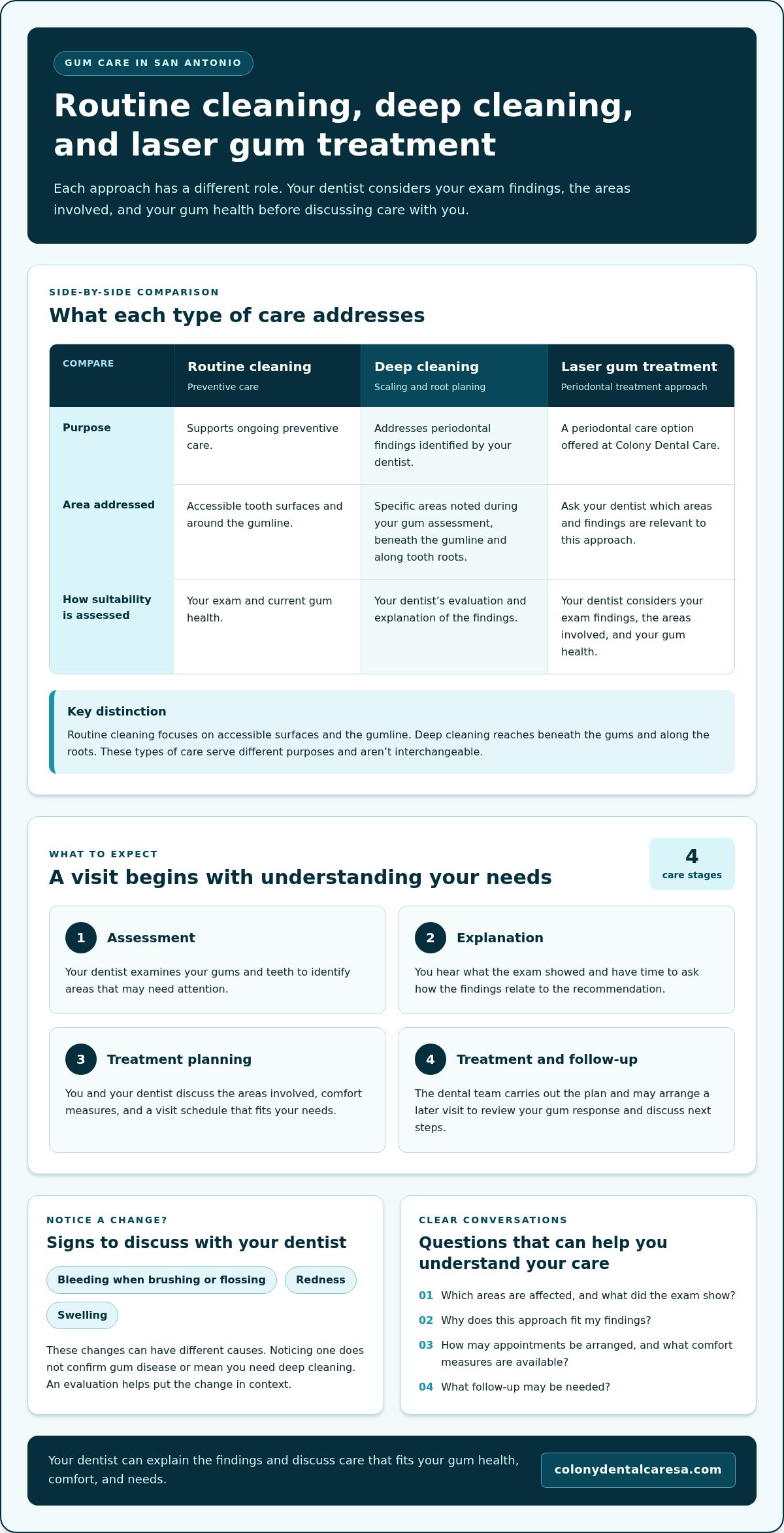
A routine cleaning is preventive care. It generally removes plaque and tartar from accessible tooth surfaces and around the gumline. Deep cleaning focuses beneath the gums and along the tooth roots, so the two serve different purposes and aren’t interchangeable.
Your dentist evaluates your gum health and explains which care fits the findings. If deep cleaning is recommended, ask which areas need treatment and what signs led to the recommendation. This helps you understand how the proposed care differs from your usual cleaning.
What gum changes should prompt an evaluation?
Bleeding when you brush or floss, redness, and swelling are changes worth discussing with a dental professional. These signs can have different causes. Noticing one doesn’t confirm gum disease or mean you need deep cleaning. An evaluation helps put the change in context and determine whether treatment is appropriate.
Tell your dentist when you first noticed the change, whether it happens regularly, and whether it affects a particular area. Mention tenderness or anything else you’ve observed while brushing. Ask what the examination shows and how those findings shape the recommendation. You’ll have a clearer understanding of your gum health and possible next steps.
What happens during periodontal scaling and root planing?
The visit starts with an assessment and a discussion of what your dentist recommends. Your dentist explains the findings and talks through a plan with you. The steps below offer a general overview. Your treatment plan and visit schedule depend on your needs.
Plaque is a sticky film of bacteria that forms on teeth. If it hardens, it becomes tartar, which brushing alone can’t remove. This overview of scaling and root planing offers background. Your dentist can explain how your exam findings guide your care.
- Assessment: Your dentist examines your gums and teeth to identify areas that may need attention.
- Explanation: You’ll hear what the exam showed and have time to ask questions. Ask what the dentist observed and how it relates to the recommendation.
- Treatment planning: You and your dentist discuss the areas involved, suitable comfort measures, and a visit schedule that fits your needs.
- Treatment and follow-up: The dental team carries out the plan and may arrange a later visit to review your gum response and discuss next steps.
The treatment name refers to two related steps. Your dental team can explain what each involves and which areas are part of your plan. Understanding the plan beforehand helps you feel prepared and know what questions to raise.
What do scaling and root planing each address?
Scaling and root planing are distinct parts of the treatment. Your dentist can explain which areas are involved and what the team will focus on. If a term or step is unclear, ask for a plain-language explanation before treatment begins. You should feel comfortable understanding what is planned.
How many visits could treatment involve?
The schedule depends on the areas being treated and your dentist’s assessment. Care may be divided across visits to address your needs and comfort. A follow-up may give your dentist a chance to review your gum response and discuss what comes next. Before treatment, ask how appointments are expected to be arranged so you can plan around work, family, or other commitments.
If dental treatment makes you uneasy, tell the team before your visit. You can discuss comfort measures and ask the dentist to explain each step as it happens. Colony Dental Care can start with a conversation about your concerns and gum health.
How do routine cleaning, deep cleaning, and laser gum treatment compare?
These options aren’t interchangeable, and a treatment name alone doesn’t tell you which one fits. Your dentist considers your exam findings, the areas involved, and your gum health before discussing an approach. Use this comparison to follow the conversation and ask how each option relates to your evaluation.
| Care type | Purpose | Area addressed | How suitability is assessed |
|---|---|---|---|
| Routine cleaning | Support ongoing preventive care | Accessible tooth surfaces and gumline | Your exam and current gum health |
| Deep cleaning | Address periodontal findings identified by your dentist | Specific areas noted during your gum assessment | The dentist’s evaluation and explanation of the findings |
| Laser gum treatment | A periodontal treatment approach offered at Colony Dental Care | Infected gum tissue, as described by the practice | Your individual evaluation and treatment needs |
Use the table as a guide for discussion, not as a way to select treatment on your own. Ask what your dentist observed, which areas the recommendation concerns, and how the approach fits your gum health and comfort. A clear explanation connects the findings to the suggested care rather than relying on a standard checklist.
When does a routine cleaning differ from periodontal treatment?
Your evaluation helps determine what kind of care is appropriate. Your preferences matter, but they don’t replace an assessment of your gum health. If your appointment is for preventive care, this guide to routine dental cleanings can help you know what to expect. If another approach is proposed, ask what findings led to that recommendation.
What should you know about laser gum treatment?
Colony Dental Care offers soft-tissue laser gum treatment for gum disease care. The treatment uses a soft-tissue laser to target infected gum tissue and often does not require sutures. Laser treatment isn’t right for every situation or automatically a substitute for another approach. Your dentist can explain how it relates to your evaluation and what to expect from the proposed plan.
For periodontal deep cleaning San Antonio care, start with a conversation about your evaluation and the options that fit it. Discuss your periodontal care with Colony Dental Care in a calm, personalized setting.
How can you prepare for treatment and support gum recovery?
Preparing ahead can help you feel more at ease and make your appointment more useful. Before treatment, share the medications you take, any health concerns, and whether dental visits make you anxious. This gives your dental team helpful context to discuss your needs and suitable comfort measures. You can also ask how your treatment will be arranged and what to expect afterward.
After treatment, sensitivity can vary. Follow the instructions your dental team gives you for your specific visit rather than relying on general timelines or advice meant for someone else. Keep up with brushing and flossing as directed, and let the team know if you notice a change or have a concern.
What questions can make the treatment plan clearer?
You deserve to understand the reason for a recommendation and how care fits your needs. Bring a short list of questions so you can talk through the plan without feeling rushed. For example, ask:
- What gum findings support the recommendation, and which areas need treatment?
- What comfort measures are suitable for me?
- Is a follow-up planned, and what will the team review?
- How might my dental insurance apply, and what payment options are available?
Reviewing your benefits and expected out-of-pocket costs before treatment can help you plan. Coverage depends on your plan, and Colony Dental Care can help explain the benefit information available to you.
What can you do after periodontal treatment?
Your dental team’s instructions are the best guide for recovery because they reflect the care you received. Brush and floss consistently as directed, and ask if you’re unsure how to clean an area comfortably. If you notice a change that concerns you, share what you’re experiencing with the practice so the team can advise you about next steps. Follow the guidance for your treatment rather than relying on a generic recovery schedule.
Where can San Antonio patients get personalized guidance?
Colony Dental Care provides periodontal disease treatment with attention to your individual needs and comfort. A useful appointment gives you room to explain what you’ve noticed, understand the evaluation, and discuss possible next steps. You can also raise practical concerns, such as how treatment may fit your schedule or what information you need to plan for care.
If you’re considering gum care in San Antonio, start by discussing your concerns rather than assuming a particular treatment is right for you. Our San Antonio dentist care guide offers an overview of the practice. You’re welcome to discuss an evaluation with Colony Dental Care and take the next step at a pace that feels comfortable.
Deep Cleaning in San Antonio at Colony Dental Care
If you’re considering periodontal deep cleaning in San Antonio, start with an evaluation and a conversation about your gum health, comfort, and goals. At Colony Dental Care, we’ll explain what we find and discuss whether periodontal care may be appropriate for you. A recommendation should relate to your gum assessment, not a generic checklist or assumption based on one symptom.
Colony Dental Care provides periodontal disease treatment, including laser gum treatment and Arestin®. Your dentist can explain which options relate to your needs and exam findings, what each may involve, and how follow-up will be handled. You’ll have time to ask questions and understand the plan.
What makes a personalized gum-care discussion useful?
A useful discussion helps you understand the reason for a recommendation, the areas it addresses, and possible next steps. Colony Dental Care uses digital X-rays, intra-oral cameras, and soft-tissue lasers as part of care. Your dental team can explain how information from your evaluation informs its recommendations and answer questions in plain language.
Share what matters to you, including dental anxiety, comfort concerns, and goals for your gum health. Ask what findings the dentist sees, what care is being proposed, and whether follow-up is planned. This gives you a chance to understand the plan and talk through concerns before deciding how to proceed.
How can you discuss insurance and payment?
Cost questions are a reasonable part of planning care. Colony Dental Care accepts many dental insurance plans and can help you understand your benefits. Coverage depends on your individual plan, so don’t assume a procedure will be covered at a particular level. Discussing benefits and expected out-of-pocket costs before treatment can help you plan with greater clarity.
Payment options include CareCredit®, Cherry Financing, Sunbit, and the in-house membership plan. Bring your insurance information and ask the team to explain the financial details that apply to your situation. You don’t need to have every question figured out in advance.
At Colony Dental Care, we treat you like a neighbor and aim to make each step personal, calm, and understandable. If you’ve noticed gum changes or have questions about a deep-cleaning recommendation, you’re welcome to schedule an evaluation with our San Antonio team. We can discuss your concerns, review your gum health, and help you consider a comfortable next step.
Take a Clear Next Step for Your Gum Health
Your gum health deserves attention that fits your needs, without pressure to decide before you feel ready. If you’ve been considering periodontal deep cleaning San Antonio care, use your next conversation to understand the recommendation, the options available to you, and what follow-up may involve. Clear answers can help you feel more confident about your next step.
Bring your questions, share what’s worrying you, and talk through comfort and payment concerns at your own pace. The goal is to leave with a clearer understanding of your options and a plan that reflects your gum health and priorities.
Schedule a periodontal evaluation with Colony Dental Care and take an informed step toward caring for your gums. You don’t have to figure everything out before you begin. A conversation is a good place to start.
Frequently Asked Questions
Is periodontal deep cleaning the same as a regular dental cleaning?
No. A regular cleaning is preventive care, while deep cleaning is periodontal treatment for concerns identified during an exam. If your appointment is for a routine cleaning but you’ve noticed bleeding or tenderness, mention it before the cleaning begins. Your dentist can assess the change and explain whether your preventive visit is appropriate or whether your gum health calls for a different plan.
Can gum disease be treated with a deep cleaning?
Yes. Scaling and root planing can be used to treat gum disease by addressing buildup beneath the gums. It doesn’t guarantee that gum disease is cured, and your needs may include ongoing care after treatment. Your dentist can explain how your exam findings inform the recommendation and what monitoring or maintenance may be appropriate for your gum health.
How long does periodontal deep cleaning take?
There isn’t one visit length that applies to everyone. Timing depends on how many areas need treatment and your dentist’s assessment. Care may be planned across more than one appointment. Before beginning, ask how treatment is expected to be scheduled and whether a follow-up is part of the plan, so you can make arrangements for work, family, or transportation.
Does periodontal deep cleaning hurt?
Comfort varies from person to person. Tell your dental team if you’re worried about discomfort, and ask what comfort measures may suit your visit. Some sensitivity can occur afterward, but your dental team can give you care instructions based on what was done. If discomfort concerns you during or after care, let the practice know.
What happens if gum disease is left untreated?
Untreated gum disease can progress and damage the tissues and bone that support your teeth. In advanced cases, teeth may become loose or be lost. Gum disease is also associated with overall health concerns, so maintaining gum health is part of caring for your well-being. If you notice persistent gum changes, an evaluation can help clarify what’s happening and whether care is needed.
Does dental insurance cover periodontal deep cleaning?
Coverage and out-of-pocket costs depend on your individual plan. Before treatment, review your periodontal benefits, deductible, and any plan requirements with your dental team. Colony Dental Care accepts many dental insurance plans and can help you understand your benefits, but coverage isn’t guaranteed. Ask for an explanation of expected costs before deciding how to proceed.
Can laser gum treatment be used instead of scaling and root planing?
Not necessarily. Laser gum treatment and scaling and root planing are different approaches, and one isn’t automatically a substitute for the other. Colony Dental Care offers soft-tissue laser treatment as part of periodontal care. Your dentist can explain whether it may fit your findings or whether another approach is more appropriate. For periodontal deep cleaning San Antonio care, the decision should follow an individual evaluation.