Last Tuesday, a neighbor named Elena discovered that a single bite of a breakfast taco could send a sharp, electric “zinger” through her jaw. It is a frustrating sensation that leaves many people asking: Why Does My Tooth Hurt When I Bite? Causes & Treatment. You might worry that an intensive procedure like a root canal is the only solution, or you might feel confused because the pain seems linked to your seasonal allergies. Since San Antonio is one of the most challenging cities for cedar and oak pollen, distinguishing between a dental issue and sinus pressure is a common hurdle for our community.
We know how these sudden jolts of pain can create anxiety and take the joy out of your favorite meals. Our friendly team is here to help you find relief and understand exactly what your tooth is trying to tell you, all without using confusing clinical jargon. You will learn about the difference between a structural crack and simple pressure from a sinus infection, as well as the gentle steps we take to help you eat comfortably again.
Key Takeaways
- Learn to distinguish between sharp “zingers” and dull aches to better understand what your body is telling you.
- Discover how hidden issues like Cracked Tooth Syndrome can cause pain even when your smile looks perfectly healthy in the mirror.
- Understand the surprising link between San Antonio’s seasonal allergies and dental discomfort as we explore Why Does My Tooth Hurt When I Bite? Causes & Treatment.
- Get practical advice on protecting your tooth and managing sensitivity while you wait for your gentle dental assessment.
- Explore how a “Comfort-First” approach to restorative care can provide lasting relief and help you enjoy your favorite foods again.
Understanding the SOS: Why Biting Down Triggers Tooth Pain
When you bite down on something as simple as a piece of toast and feel a sharp flash of pain, it’s your body’s way of sending an SOS. This specific sensation is often different from a constant toothache because it only happens when you apply pressure. Understanding Why Does My Tooth Hurt When I Bite? Causes & Treatment starts with recognizing that your teeth aren’t just solid blocks. They are complex structures connected to your jaw by incredibly sensitive tissues. Catching these signals early is a great way to ensure we can provide gentle, non-invasive care that preserves your natural smile. Most of the time, a tooth that hurts under pressure is still salvageable if we address the underlying stress before it leads to a more significant fracture.
The Mechanics of Pressure-Induced Pain
Inside your teeth are tiny channels called tubules that are filled with microscopic fluid. When you bite down, the pressure can shift this fluid and trigger the nerves deep within the tooth’s pulp. You also have a specialized tissue called the periodontal ligament surrounding the root. Think of this as a tiny, biological shock absorber that holds your tooth in place and cushions it against the force of chewing. If this ligament becomes bruised or inflamed, even light pressure can feel quite intense. Biting pain is a clear signal that the internal or external integrity of your tooth is currently under stress.
Sharp vs. Dull: What Your Pain Style Means
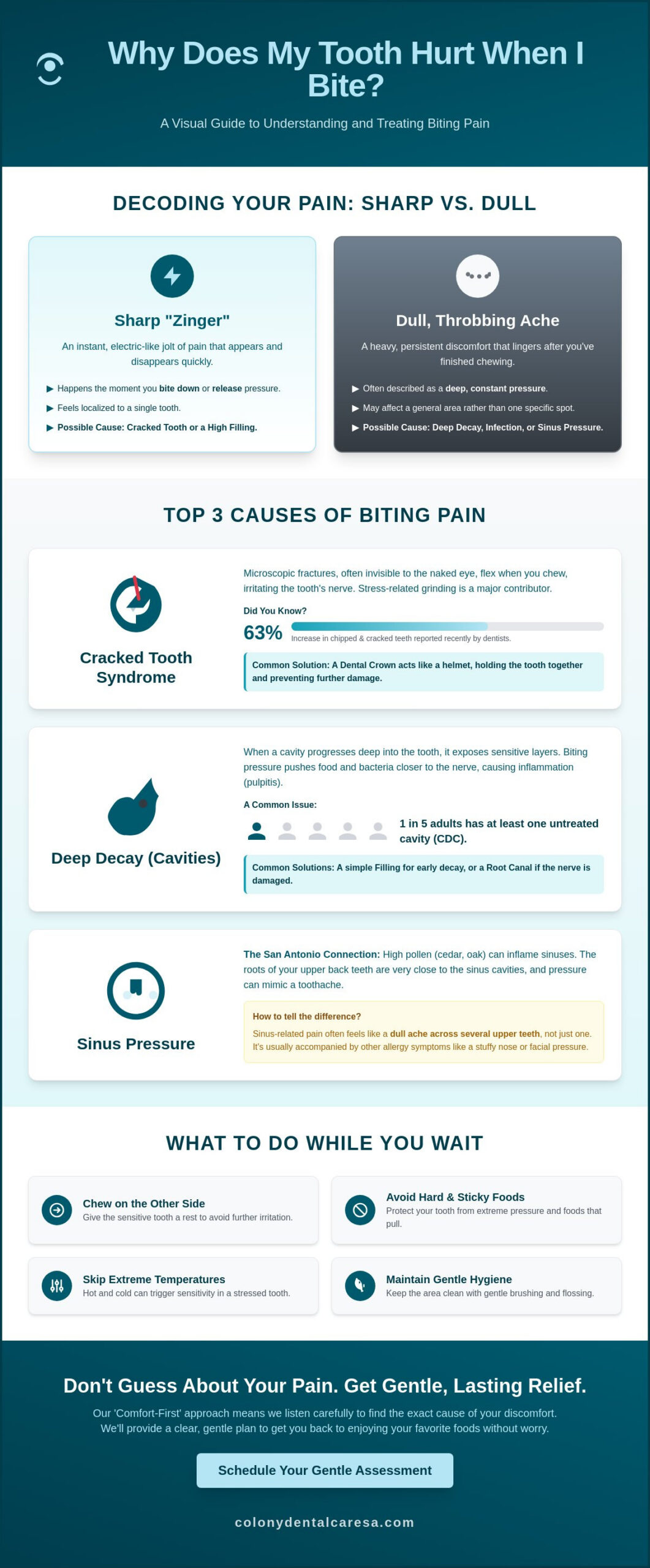
The specific type of discomfort you feel tells us a lot about what’s happening under the surface. If you experience a sharp “zinger” that happens the moment you bite down or release pressure, you might be dealing with Cracked tooth syndrome. This can also happen if a dental filling is just a tiny bit too “high” and takes on more force than the rest of your teeth. Conversely, a dull, heavy ache that lingers after you’ve finished chewing usually suggests deep decay or a possible infection. We always encourage you to pay attention to the timing of your symptoms. Does it happen only with hard foods? Is it triggered by cold drinks? Knowing these answers helps us create a personalized plan to get you back to eating comfortably. We want to help you find the cause quickly so we can protect your tooth and your peace of mind.
Our goal is to make sure you feel seen and heard during your visit. By identifying whether the issue is a simple structural tweak or something requiring more thorough care, we can ensure your experience is methodical and unhurried. You don’t have to guess why your tooth is acting up; we’re here to provide the professional confidence and neighborly care you deserve.
The Most Common Dental Culprits Behind Biting Sensitivity
When we see neighbors in our San Antonio office, we often find that biting pain stems from a handful of very specific dental conditions. Understanding Why Does My Tooth Hurt When I Bite? Causes & Treatment involves looking closely at the internal and external health of your teeth. While some issues are visible to the naked eye, others hide beneath the surface, requiring a gentle and thorough examination to uncover. We prioritize your peace of mind by identifying these culprits early, which often makes for a much simpler and more comfortable repair process.
Cracked Tooth Syndrome (CTS)
CTS is one of the leading reasons for unexplained biting pain. These microscopic fractures are often too small to see in a mirror, and they may not even show up on a standard X-ray. When you chew, the crack flexes open and then snaps shut, which irritates the sensitive nerve inside. This “rebound pain” is a classic sign of a fracture. It’s a common issue today, as dentists have reported a 63% increase in chipped and cracked teeth recently, often due to stress-related grinding. To protect the tooth from further damage and restore your comfort, dental crowns are often the gold standard. They act like a protective cap, holding the tooth together so you can eat your favorite local foods without worry.
Deep Decay and Pulpitis
Another common culprit is advanced tooth decay. As of 2024, the CDC reports that 1 in 5 adults aged 20 to 64 has at least one untreated cavity. When a cavity reaches the deeper layers of your tooth, it can act like a wedge, pushing food and pressure directly into the sensitive dentin or pulp. This often leads to pulpitis, which is simply an inflamed tooth nerve. If the inflammation is reversible, a simple filling might do the trick. However, if the nerve is too damaged, root canal therapy can often save a tooth from extraction, removing the source of the pain while keeping your natural smile intact.
Sometimes the issue isn’t a crack or a cavity. You might also experience biting pain due to a dental abscess or a “high filling.” An abscess is an infection at the root that creates pressure in the surrounding bone, while a high filling occurs when a new restoration is slightly too tall, causing that tooth to hit before the others. Both conditions can make your tooth feel bruised and sensitive. If you’re feeling that sharp zinger every time you chew, our team is ready to help. You can schedule a gentle exam to find the exact cause of your discomfort and get back to eating comfortably.
Is It My Tooth or My Sinuses? The San Antonio Connection
Living in San Antonio means we are all too familiar with the intense allergy seasons that sweep through our community. Our city is frequently ranked as one of the top 10 most challenging places in the United States for seasonal allergies. From the notorious “Cedar Fever” that peaks between December and February to the heavy oak and pecan pollen in the spring, our sinuses are often under constant attack. Many of our neighbors are surprised to find that their seasonal congestion is actually the answer to Why Does My Tooth Hurt When I Bite? Causes & Treatment. Because your oral health is deeply connected to your overall well-being, understanding this regional link is the first step toward finding relief.
How Sinus Pressure Mimics a Toothache
The anatomy of your face plays a major role in how you experience pain. Your maxillary sinuses are located directly above the roots of your upper back teeth. When these cavities become inflamed or filled with fluid due to allergies, they can press down on the dental nerves. This pressure often creates a dull, heavy ache that feels like it’s coming from several teeth at once rather than a single spot. You might notice that the discomfort shifts or intensifies when you bend over to pick something up or when you move your head quickly. It’s a frustrating sensation, but knowing the cause can help alleviate the anxiety of a potential dental emergency.
The “Jump Test” and Other Home Indicators
If you’re trying to figure out the source of your discomfort at home, we often suggest a simple “jump test.” If you experience a sharp jolt of pain in your upper jaw when you jump or walk heavily, it is a strong indicator that sinus inflammation is the culprit. You should also check for a cluster of other symptoms, such as nasal congestion, ear pressure, or a recent cold. While there are many potential causes for tooth pain, sinus-related issues rarely affect just one tooth. If the pain is strictly isolated to a single tooth, it’s much more likely to be a structural issue like a crack or deep decay.
We want you to feel comfortable and cared for, regardless of the source of your pain. While home checks are helpful, only a professional clinical exam can rule out a concurrent infection or a hidden dental issue. Our team uses a methodical, unhurried approach to help you distinguish between a “San Antonio sinus” problem and a dental concern. We’re here to be your trusted advisors, ensuring you get the right care to help you breathe and eat easily again.
What to Do While You Wait for Your Appointment
Waiting for a dental appointment can feel stressful when every meal reminds you of a problem. We want to ensure you stay as comfortable as possible while we prepare to see you. Understanding Why Does My Tooth Hurt When I Bite? Causes & Treatment is about more than just a diagnosis; it is about protecting your health in the meantime. By taking a few gentle precautions at home, you can prevent further stress on your tooth and keep your pain levels manageable while you wait for our team to help.
Home Comfort Measures
One of the best things you can do is avoid extreme temperatures. Hot coffee or ice-cold water can send a shock to an already sensitive nerve, so try to stick to room-temperature beverages for now. It is also helpful to chew on the opposite side of your mouth. This simple change gives your tooth a much-needed break from the mechanical force that might be widening a small crack or irritating an inflamed ligament. We recommend choosing soft, nourishing foods like yogurt, smoothies, or soup to minimize chewing effort. While over-the-counter anti-inflammatories can help dull the ache, remember that they only mask the symptoms rather than fixing the cause. Resist the urge to “test” the tooth by biting down repeatedly to see if it still hurts. This can worsen the underlying issue. If you notice gum irritation, a warm salt water rinse is a soothing way to keep the area clean and calm.
When It Is a Dental Emergency
Most biting pain can wait a day or two for a scheduled visit, but some signs require immediate attention. If you experience facial swelling, a high fever, or notice a small, pimple-like bump on your gums, you should not wait. These are red flags that an infection may be spreading and requires urgent care. In these cases, contacting an emergency dentist in San Antonio is the safest course of action. Dr. Oei is committed to seeing urgent cases promptly because your peace of mind and comfort are our top priorities. We are here to guide you through these moments with professional confidence and a neighborly touch. If you are experiencing any of these severe symptoms, please reach out to our team immediately so we can provide the relief you deserve.
Gentle Solutions at Colony Dental Care
At Colony Dental Care, we understand that finding the answer to Why Does My Tooth Hurt When I Bite? Causes & Treatment is only half the journey. The other half is feeling safe and heard while you get the help you need. Dr. Oei brings over 30 years of experience to our San Antonio community, specializing in diagnosing the complex causes of biting pain. We know that dental anxiety is real, and we’ve designed our “Comfort-First” philosophy to ensure your peace of mind from the moment you walk through our doors. You aren’t just another case number to us; you’re a neighbor who deserves a pain-free life.
Advanced Diagnostics for Peace of Mind
Sometimes, the reason for a sharp zinger is hidden deep within the tooth structure. While traditional X-rays are a vital tool, they can occasionally miss the microscopic fractures associated with Cracked Tooth Syndrome. We utilize modern diagnostic techniques to identify the exact source of your discomfort with precision and care. This thoroughness allows us to create a treatment plan that is methodical and unhurried. Our primary goal is always to save your natural teeth whenever possible, preserving your oral health and your confidence for years to come. We take the time to explain our findings without using clinical jargon, so you always feel in control of your care.
Reclaiming Your Smile with Personalized Care
Once we identify why your tooth is reacting to pressure, we offer a variety of gentle restorative solutions tailored to your specific needs. From durable, tooth-colored fillings that blend seamlessly with your smile to custom dental crowns that provide a protective shield, our treatments are designed for both beauty and function. We also understand that many people delay care due to concerns about costs. To help our neighbors stay healthy, we invite you to join our in-house dental membership. This plan offers a predictable way to manage your family’s dental health without the stress of traditional insurance hurdles. It’s just one of the ways we show our commitment to being a dedicated local fixture in San Antonio.
You don’t have to live with the fear of that next painful bite. Our team is here to guide you through a supportive experience that prioritizes your comfort above all else. Whether you need a simple adjustment or more thorough restorative work, we approach every appointment with professional confidence and a kind, approachable touch. We want to help you eat, laugh, and smile with ease again. Schedule your gentle exam at Colony Dental Care today and let us help you find the relief you’ve been looking for.
Reclaim Your Peace of Mind and Your Smile
We have explored how everything from microscopic fractures to the unique pressure of San Antonio “Cedar Fever” can provide the answer to Why Does My Tooth Hurt When I Bite? Causes & Treatment. Understanding that your discomfort might be a simple structural fix or a temporary reaction to seasonal allergens helps take the mystery out of your dental health. Our team is dedicated to providing the clarity you need to move forward without fear. We prioritize your comfort and individual needs during every step of the process.
Dr. Oei and our team bring over 30 years of San Antonio experience to our practice, offering compassionate, comfort-focused care that feels like visiting a trusted neighbor. If you don’t have insurance, our in-house dental membership provides a stable and predictable way to maintain your oral health. You deserve to enjoy your favorite local meals without the worry of a sudden “zinger.” We are ready to help you find lasting relief in a methodical and unhurried environment. Schedule Your Reassuring Dental Exam Today and let us help you smile with confidence again.
Frequently Asked Questions
Why does my tooth only hurt when I release my bite?
Pain that occurs specifically when you let go of a bite is often called “rebound pain.” This is a classic symptom of a cracked tooth. When you bite down, the pieces of the tooth move apart, and when you release, they snap back together, which irritates the sensitive nerve inside. It is one of the most common reasons people ask Why Does My Tooth Hurt When I Bite? Causes & Treatment.
Can a cracked tooth heal on its own without a dentist?
No, a tooth cannot heal a crack the way a broken bone can. Because enamel is not a living tissue, it doesn’t have the ability to knit itself back together. If left untreated, the constant pressure of chewing will likely cause the crack to grow deeper. We always recommend addressing these issues early to prevent the need for more complex care later on.
Is it normal for a new filling to hurt when I bite down?
It is relatively common for a new filling to feel sensitive if it is slightly “high.” This means the new material is hitting your opposite teeth before the rest of your bite connects, which can bruise the ligament around the tooth root. A very simple, quick adjustment in our office usually resolves this discomfort immediately and restores your natural bite alignment.
How can I tell if my tooth pain is from a sinus infection?
Sinus-related pain usually feels like a dull, heavy pressure that affects several upper back teeth at once. If you notice the ache gets worse when you bend over or if you have other symptoms like nasal congestion, it’s likely a sinus issue. Dental pain is typically isolated to just one specific tooth and feels much sharper when you apply direct pressure.
What happens if I ignore a tooth that hurts when I chew?
Ignoring biting pain can lead to more significant problems, such as a localized infection or a complete tooth fracture. What starts as a small crack that could be fixed with a crown might eventually turn into a split that requires an extraction. We want to help you avoid these outcomes by providing a gentle, early assessment to keep your natural smile healthy.
Will I definitely need a root canal if it hurts to bite?
Not necessarily. Many cases of biting pain are resolved with simpler treatments like a minor filling adjustment or a protective crown. We only recommend root canal therapy if our diagnostic tools show that the internal pulp of the tooth is actually infected or irreversibly inflamed. Our goal is always to find the most conservative solution that restores your comfort.
How much does it cost to fix a tooth that hurts when biting?
The cost depends entirely on the underlying cause, which is why a thorough exam is the first step. A simple adjustment is quite affordable, while a crown or a filling involves different restorative steps. We believe in total transparency and will provide you with a clear, personalized estimate before any work begins. If you don’t have insurance, our in-house membership plan is a great way to make your care more predictable.
Can gum disease cause pain when I bite down?
Yes, because periodontal disease affects the bone and ligaments that hold your teeth in place. When these support structures are inflamed or weakened, the tooth can shift slightly or feel very tender when you put pressure on it. This is why we look at your total oral health during your visit, ensuring we treat the root cause of Why Does My Tooth Hurt When I Bite? Causes & Treatment.