
What helps a dentist feel connected to the community she serves? A hometown doctor story is about more than where someone grew up. It can also show how education, career choices, and personal values shape a dentist’s approach to care and relationships with patients. Those connections can make a professional story feel close to home.
You may want to know more than a dentist’s credentials. The path behind them can offer context about what influenced her decisions and how she views her role in the community. Understanding that journey can help you see the person behind the profession, while recognizing the skill and preparation dental care requires.
This article explores how a hometown dentist’s training and career can relate to the community she serves. You’ll learn how a professional path connects with local life, and why those roots matter in San Antonio. The story offers a personal perspective on care grounded in experience and community connection.
Key Takeaways
- See how a dentist’s training can shape the way she listens, makes care decisions, and builds trust with patients.
- Learn why ties to a hometown can influence a dentist’s connection with the people and community she serves.
- Follow the path from education into practice and consider how those experiences shape a dentist’s approach.
- Find out how regular dental exams and cleanings can support an ongoing relationship with your dental team.
Relationships between a doctor and her community
In San Antonio, a dentist’s community connection can be understood through the people and practice tied to local care. Colony Dental Care was founded by Dr. James David Oei in 1994. That gives the story a concrete local anchor: a named dentist, a practice, and a history of serving San Antonio residents. It does not tell us every detail of Dr. Oei’s personal relationships, but it does show how a professional career can become part of a community’s everyday life.
Situation: building a practice in San Antonio
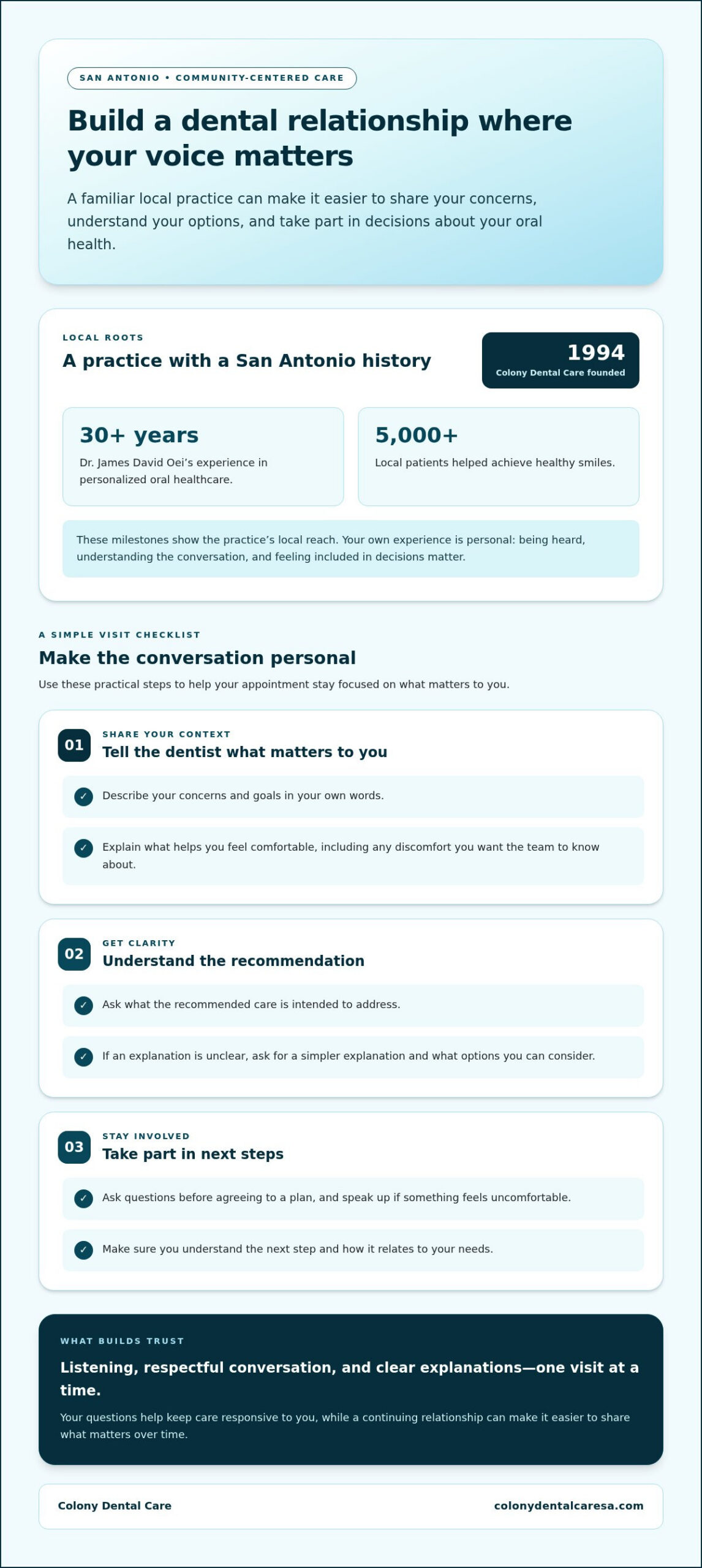
Starting a practice creates a place where local residents can seek dental care over time. Dr. Oei founded Colony Dental Care in 1994, and he has over 30 years of experience in personalized oral healthcare. Those facts connect his professional path with the city where the practice serves patients. They also offer a useful way to think about community ties: they are shaped not only by where a dentist lives, but by the care relationship a local practice makes possible.
The practical value of a local dental relationship is the opportunity to discuss your concerns and goals with a familiar practice. During an appointment, describe what helps you feel comfortable, ask questions about recommended care, and explain what you hope to address. These details help make the conversation personal rather than routine. A community-focused approach starts by listening, not assuming every San Antonio resident has the same priorities.
Action: making care personal
Colony Dental Care’s approach centers on personalized oral healthcare. That matters in a community setting, where people arrive with different needs, histories, and comfort levels. You can help make a visit useful by sharing your concerns and asking for a clear explanation of next steps. The dentist can then discuss care relevant to your needs, rather than treating the appointment as a one-size-fits-all exchange.
Trust also depends on clear communication. If a recommendation is unclear, ask what it addresses and what options you can consider. This practical step can make any dental conversation easier to follow, whether you are discussing routine care or a concern that has been bothering you. Feeling heard grows through respectful exchanges and understandable explanations.
Result: a local relationship that can continue
Colony Dental Care has helped over 5,000 local patients achieve healthy smiles. That figure shows the practice’s reach among San Antonio residents, while each individual’s experience remains personal. A number alone cannot describe a relationship. The meaningful measure for you is whether you can share your concerns, understand the conversation, and feel included in decisions about your oral health.
A dentist’s community connection is most useful when it supports continuity and open communication. Explain your goals, speak up about discomfort, and ask questions before agreeing to a plan. Dr. Oei’s long-standing work in San Antonio provides local context for this story; your conversations help make care responsive to you. Community roots and individual attention can build trust, one visit at a time.
Community ties can also be viewed through the practical conditions that shape access to care. Jordan Baxter says road conditions in her rural Montana community are unpredictable for almost eight months of the year. That account points to a challenge that can affect how people approach appointments: reaching care may not be equally straightforward throughout the year. For a local practice, recognizing that travel conditions can be uncertain is one way to understand the circumstances patients bring with them. Clear conversations about concerns and care goals can help keep the relationship centered on the person, even when getting to an appointment is difficult.
The wider path into medicine is another part of the community picture. The number of medical students from rural areas declined by 28% between 2002 and 2017. This fact offers a reason to value the connection between a community and the people who provide its care, without assuming that every place faces the same circumstances. For patients, a continuing relationship with a dentist can make it easier to explain what matters to them and ask questions over time. For practitioners, listening to those concerns is a meaningful way to recognize the people and conditions that make up the community they serve.
The doctor’s training and career path
A dentist’s career is shaped by education, clinical practice, and decisions made along the way. Dr. James David Oei has a long-standing career in San Antonio. A dentist’s training matters because it helps explain how knowledge informs judgment in the office. Rather than inventing a personal education timeline, we can consider how a career in dentistry connects to the choices you discuss as a patient.
Situation: turning study into practical skill
Dental education prepares a professional to assess oral health and plan care. In practice, that means considering what an examination reveals alongside the concern you bring to your appointment. You may want to understand a change in a tooth, discuss a treatment recommendation, or learn what a proposed next step involves. The useful question is how a dentist’s preparation supports clear, reasoned decisions in situations like these.
For San Antonio residents, a dentist’s background is relevant without needing to become a list of credentials. Training is the foundation; professional judgment is how that foundation is applied. Ask what a recommendation is intended to address and how the dentist reached it. A clear explanation helps you understand the reasoning and share information that may affect your goals or comfort.
Action: applying knowledge through patient conversations
You can follow the path from dental knowledge to a care plan in practical steps. First, describe your concern in your own words. Next, listen as the dentist explains the finding and related options. Then ask about anything that remains unclear. These steps keep the discussion focused on your needs instead of leaving you to guess what a clinical term or recommendation means.
Dr. Oei’s career is rooted in San Antonio, where patients bring different questions and priorities. A useful professional conversation connects dental knowledge with the person seeking care. If a recommendation feels unfamiliar, ask what it involves and why it relates to your concern. That exchange turns professional expertise into information you can use when considering your next step.
Result: understanding the career behind your care
A career in dentistry is more than a sequence of educational milestones. It also involves applying knowledge to individual needs, explaining choices, and listening carefully. During an appointment, look for clear answers rather than relying on a biography alone to describe your care experience. A dentist’s training matters most when it supports an understandable discussion about your oral health.
Dr. Oei’s career in San Antonio gives this article its local perspective, while your questions can make a visit specific to you. Raise the issue you want addressed, ask what an examination or recommendation means, and take time to understand the options discussed. These steps help you play an active role in your care and show how professional preparation and patient communication meet in everyday dental practice.
Health-care training can include experiences that shape a person’s interest in caring for others. Wyatt Bowles took a Certified Nursing Assistant class in high school and worked in a nursing home. Bowles also began thinking about a future in medicine as a preteen. Those details show how early exposure to patient care can come before formal study, but they do not establish anything about Dr. Oei’s background. Training paths may combine classroom learning and practical experience, with the balance varying by profession and program.
Wyatt Bowles began his University of Washington training in Moscow, Idaho, in 2020. WWAMI students spend their first 18 months taking essential science courses before clinical training. Jordan Baxter had helped with 10 deliveries while studying family medicine and obstetrics in Miles City, Montana. Jordan Baxter was scheduled to go to Seattle in October to study pediatrics and psychiatric services. These examples concern medical education and clinical work, rather than dental training, but they underline why it is useful to distinguish a person’s documented career history from general features of health-profession education. For patients, the practical value of asking about a dentist’s preparation is to understand how it relates to the care being discussed. A conversation can focus on the dentist’s experience with a concern, the reasoning behind an option, and what a patient should expect from the next step. That approach keeps the focus on informed decisions while avoiding assumptions about credentials or training that have not been confirmed.
Colony Dental Care: Dental Cleanings and Exams
Colony Dental Care provides Dental Cleanings and Exams for San Antonio residents seeking ongoing dental care. These visits give you time to discuss concerns, have your teeth examined, and receive a professional cleaning. Regular appointments can also identify changes that may need attention, helping you understand your options and next steps.
If an exam finds a cavity, Tooth-Colored Fillings can restore the affected tooth with material designed to blend with natural teeth. The practice also offers Invisalign Clear Aligners and Tooth Extractions. The right service depends on your needs, and a clear conversation can help you understand the recommended care.
To arrange an exam or cleaning, contact Colony Dental Care in San Antonio.
Make Your Next Dental Visit Feel More Personal
A hometown doctor story can remind us that trust grows through thoughtful conversations. At your next visit, share what helps you feel comfortable, ask questions, and make sure you understand the recommended care. You should feel included in decisions about your smile, whether you’re maintaining your oral health or considering a change.
Colony Dental Care provides Dental Cleanings and Exams, Tooth-Colored Fillings, and Invisalign Clear Aligners in San Antonio. If one of these services fits your needs, a conversation can help you understand the next step and feel prepared for your visit. Share your concerns at your own pace and discuss the options that relate to your goals.
When you’re ready to begin that conversation, contact Colony Dental Care. A thoughtful next step can make caring for your smile feel more manageable.

