What if that sensitive spot on your tooth isn’t a permanent “hole” just yet? Many of us have felt that familiar pang of worry while brushing, wondering if a stressful appointment is inevitable. You might find yourself asking, Can Cavities Go Away on Their Own? while hoping for a way to avoid the drill and keep your costs down.
If you have already reached a point where decay is deep, it is important to know that you still have options. Professional resources like U-First Dental Care offer specialized Root Canal Therapy to remove infection and restore the tooth, providing a path back to health even after a cavity has progressed.
We understand how those anxieties can weigh on you, and we believe you deserve a path to health that feels safe and supportive. It’s a common misconception that every spot of decay requires a filling. In fact, the latest 2026 clinical guidelines from the WHO highlight a shift toward minimally invasive care that prioritizes preserving your natural tooth structure whenever possible.
In this article, we’ll show you the science of remineralization and how you can actually reverse early dental damage before it becomes a permanent cavity. You’ll learn the difference between “early decay” and a physical hole, along with gentle options like fluoride treatments and dental sealants that protect your smile. Let’s look at how we can partner together to catch issues early and keep your care simple, affordable, and comfortable.
Key Takeaways
- Learn to distinguish between “incipient decay,” which we can often reverse, and a permanent cavity that requires professional care.
- Discover the biological window for natural healing to answer the question: Can Cavities Go Away on Their Own?
- Identify the “white spot” warning sign that indicates your enamel is losing minerals but hasn’t yet formed a physical hole.
- Understand how choosing a simple, tooth-colored filling today protects your health and prevents the need for more complex root canal therapy later.
- Explore how a gentle, comfort-focused environment can transform your dental experience and ease any anxieties about treatment.
The Science of Tooth Decay: Is “Self-Healing” a Myth or Reality?
Think of your tooth enamel as a living landscape that changes every single day. Many people ask us, Can Cavities Go Away on Their Own? while looking at a small spot in the mirror. To answer that, we have to look at The Science of Tooth Decay as a dynamic mineral exchange rather than a one-way street. Your teeth are constantly losing and gaining minerals in a process that never truly stops.
We often hear the myth that teeth can “self-heal” just like a scratch on your skin. Unfortunately, that isn’t quite how our bodies work. While your skin creates new cells to close a wound, your enamel is the only part of your body that doesn’t have living cells to regenerate itself. Once a physical hole forms, the tooth cannot regrow that lost structure. However, there’s a specific window where we can help your tooth strengthen itself before a drill is ever needed.
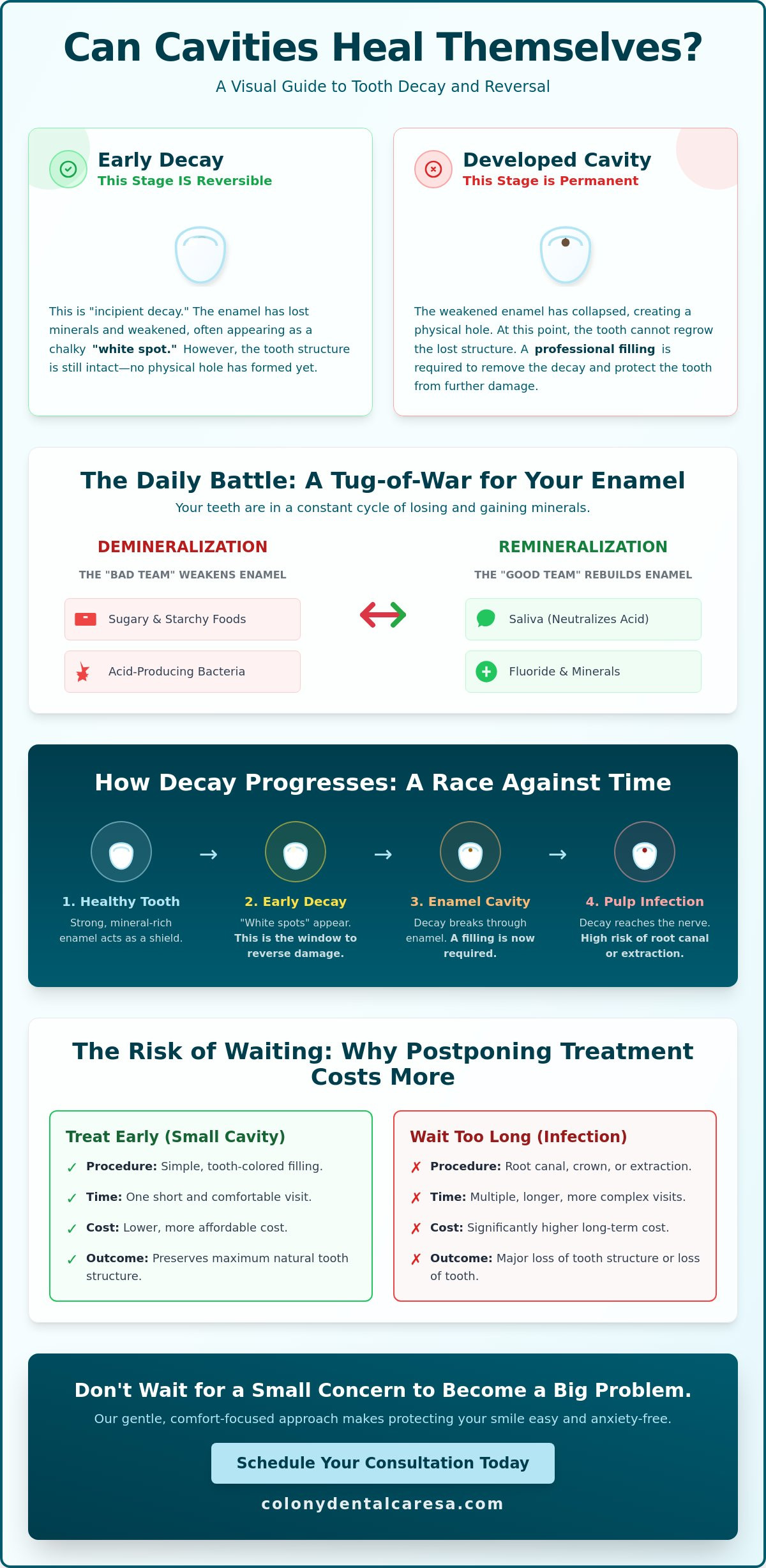
The secret lies in the difference between “incipient decay” and a “cavity.” Incipient decay is the very beginning of the process. It’s a stage where the enamel has softened but hasn’t yet broken. At this point, the answer to “Can Cavities Go Away on Their Own?” is actually a hopeful yes, provided we use the right tools to encourage remineralization. Once that decay crosses the line into a physical cavity, it becomes a permanent hole that requires professional care to protect the rest of your smile.
The Anatomy of a Tooth: Enamel, Dentin, and Pulp
Your enamel is a non-living shield. It’s the hardest substance in your body, designed to withstand years of chewing and talk. Because it doesn’t have living cells, it cannot regrow once a hole forms. Beneath this shield lies the dentin. This layer is much softer and contains tiny tubules that lead directly to the tooth’s center. If decay reaches the dentin, it travels much faster because the “armor” is gone. At the very center is the pulp, which we call the “heart” of the tooth. The pulp contains the nerves and blood vessels that keep the tooth vital. Our primary goal is always to protect this sensitive core from infection.
The Tug-of-War: Demineralization vs. Remineralization
Your mouth is the site of a constant tug-of-war between two opposing teams. To keep your smile healthy, we want to make sure the “Good Team” always has the upper hand.
- The Bad Team: This group includes sugary snacks, starchy foods, and acid-producing bacteria that strip minerals away from your enamel.
- The Good Team: This side is led by your saliva, which neutralizes acid, along with fluoride and a mineral-rich diet that feeds your teeth.
Remineralization is the natural process of restoring vital calcium and phosphate to your enamel to fill in weak spots before they break. By tipping the scales in favor of the Good Team, we can often stop early decay in its tracks and avoid the need for a filling.
How to Reverse Early Tooth Decay Before It Becomes a Cavity
Catching decay in its earliest stages is the key to avoiding the dental drill. Many patients ask us, Can Cavities Go Away on Their Own? while looking at a small, chalky white spot on their tooth. This “white spot” is a critical warning sign that minerals are leaving your enamel. It’s the final stage where reversal is still possible through a process we call remineralization. At this point, the tooth structure is weak but hasn’t yet collapsed into a physical hole.
Your saliva is actually your mouth’s most powerful natural defense system. It acts as a constant mineral bath, neutralizing the acids produced by bacteria and redepositing calcium and phosphate into your enamel. When we talk about “watching” a tooth during your visit, we aren’t just waiting for a problem to happen. We are practicing active surveillance. This means we monitor that specific area to see if your home care and our professional interventions are successfully hardening the enamel again. This proactive approach is a major focus during our dental cleanings in San Antonio, where we can identify these spots before they require a filling.
If we notice these early signs, we may recommend specific steps to tip the scales back in your favor. Knowing the Signs Your Cavity Requires a Filling helps us decide when a tooth needs a restoration versus when we can continue with a conservative, wait-and-watch strategy. If you’re concerned about a new spot on your tooth, scheduling a dental exam and cleaning is the best first step to take control of your oral health.
The Power of Fluoride and Minerals
Fluoride acts like a magnet for the minerals in your saliva, pulling them into the weak spots of your enamel to create a new, harder surface. We are fortunate in San Antonio because our community water is fluoridated, providing a baseline of protection for everyone in our neighborhoods. For patients who have a higher risk of decay, we often suggest professional fluoride treatments. these concentrated applications provide a significant boost to the remineralization process, helping to answer the question of Can Cavities Go Away on Their Own? with a confident, supported “yes” during those early stages.
Dietary Adjustments That Stop Decay in Its Tracks
What you eat matters, but how often you eat it is even more important. Every time you snack on starchy or sugary foods, your mouth stays in an acidic state for about 20 minutes. If you snack frequently, your teeth never get a chance to recover. Switching to xylitol-rich gums or snacks can actually inhibit the growth of decay-causing bacteria. We also encourage a diet rich in calcium and plenty of water. Staying hydrated keeps your saliva flowing freely, which maintains a healthy pH balance and gives your teeth the resources they need to stay strong and healthy.
When the Window Closes: Signs Your Cavity Requires a Filling
While we always hope to reverse early mineral loss, there is a specific moment when the tug-of-war in your mouth reaches a tipping point. We call this the “point of no return.” It occurs when the enamel surface finally gives way and a physical breach forms. Once that protective wall is broken, the answer to Can Cavities Go Away on Their Own? is a clear no. At this stage, bacteria have found a permanent hiding place inside the tooth where your toothbrush and saliva simply cannot reach them.
One of the most common misconceptions we hear is that a lack of pain means a tooth is healthy. In reality, early-stage cavities are almost always silent. If you wait for a toothache to tell you something is wrong, the decay has likely already traveled through the enamel and into the sensitive dentin. Catching these issues while they are still small and painless allows us to use conservative tooth-colored fillings to restore your smile. These modern restorations are designed to blend perfectly with your natural enamel, making them virtually invisible to anyone but a professional.
Visible and Physical Symptoms of a Permanent Cavity
Your tooth often provides subtle clues that the window for natural reversal has closed. You might notice a tiny dark pit or a brown stain that stays put regardless of how well you brush. Other common indicators include a “chalky” or rough texture that feels different to your tongue. If you experience sensitivity to cold water or sweets that lingers for more than a few seconds, it’s a sign that the decay is approaching the nerves. Additionally, if food consistently gets stuck in the same spot every time you eat, you may have a hidden cavity that has created a small trap in your tooth structure.
Why X-Rays are Essential for “Between-Teeth” Cavities
Even with a very careful visual exam, some decay remains hidden from view. These “floss-level” cavities start on the sides of your teeth where they touch their neighbors. They are impossible to see with the naked eye until they become quite large and potentially problematic. This is why we rely on digital X-rays as a vital part of our diagnostic process. Dr. Oei uses these high-resolution images to spot hidden decay in its earliest form. By identifying these spots through thorough diagnostics, we can provide gentle, targeted treatment that preserves as much of your natural tooth as possible, keeping your care simple and comfortable.
The Risk of Waiting: Why Postponing Treatment Costs More
We understand that life gets busy and dental visits aren’t always at the top of the to-do list. However, once that physical breach in your enamel happens, the biological clock starts ticking. If you’ve been asking, Can Cavities Go Away on Their Own? the answer at this stage is a gentle call to action. Postponing a simple repair doesn’t just prolong the issue; it allows the decay to burrow deeper into the tooth’s structure, where it can cause significant damage.
When decay is left alone, bacteria move through the soft dentin and can eventually create a dental abscess. This is a painful infection at the root tip that doesn’t just stay in your mouth. Oral infections are closely linked to your overall systemic health, and leaving them untreated can impact your total well-being. By choosing to address a small issue now, you’re making a wise decision for your comfort and your long-term health. We are here to partner with you in this journey, ensuring you feel supported every step of the way.
From Filling to Root Canal: The Escalation of Decay
When decay stays on the surface, a simple tooth-colored filling is often all we need to restore your tooth’s strength. If you wait, those bacteria eventually reach the pulp, which is the tooth’s “heart.” This is when you might transition from mild sensitivity to a situation requiring emergency dental care to find relief. At this point, root canal therapy usually becomes the best option to save your natural tooth. It’s helpful to remember that a root canal is a comfort-saving procedure designed to stop your pain and preserve your smile, not something to fear.
Financial Peace of Mind in San Antonio
Many of our neighbors delay care because of concerns about cost or insurance. We want you to know that we are here to help you plan, not judge your progress or your past dental history. A small filling today is a smart investment that prevents the need for a more complex crown or extraction later. For those in our San Antonio community without traditional dental insurance, our in-house membership plan makes “waiting” completely unnecessary. Routine exams and cleanings are the ultimate money-saver because they let us catch decay while it’s still in the reversible phase we discussed earlier. If you’re ready to protect your smile with a team that truly cares about your comfort, contact us at Colony Dental Care to schedule your next visit.
Gentle Cavity Care at Colony Dental Care: What to Expect
We understand that the thought of a dental visit can bring up feelings of worry. Our goal at Colony Dental Care is to replace that anxiety with peace of mind. Dr. Oei brings over 30 years of experience to our San Antonio community, providing the kind of gentle, personalized care that makes you feel like a neighbor rather than just a patient. When you’re wondering, Can Cavities Go Away on Their Own? you deserve an honest, compassionate answer that considers your unique health needs and goals.
Our practice is built on a foundation of comfort. From the moment you walk through our doors, you’ll notice a warm environment designed to soothe. We also maintain a strict no-judgment philosophy. We aren’t here to lecture you on past habits or missed flossing days. Instead, we focus entirely on your future health and how we can work together to achieve your goals. This holistic approach means we see the big picture. We know that a healthy smile is a vital part of your overall systemic well-being, and we treat it with the thoroughness it deserves. By looking at the connection between your oral health and your body, we help you maintain vitality for years to come.
Your First Visit for a Suspected Cavity
Your first visit with us is a step-by-step journey of discovery. We begin with a reassuring dental exam that uses modern, minimally invasive techniques to assess the health of your enamel. We use high-resolution imaging to show you exactly what we see. We don’t just tell you what needs to be done; we involve you in the decision-making process. Whether we are discussing remineralization strategies or the need for a tooth-colored filling, we explain every option clearly. You’ll leave with a personalized treatment plan that prioritizes your comfort and long-term vitality. We want you to feel empowered and heard every step of the way.
Taking the Next Step Toward a Healthy Smile
If you’ve been putting off an appointment because you weren’t sure if your tooth could heal itself, now is the perfect time for a peace of mind exam. Knowing the answer to Can Cavities Go Away on Their Own? in your specific case can save you from future discomfort and higher costs. Our San Antonio office is a local fixture dedicated to serving our community with stability and kindness. We invite you to experience dental care that feels safe, methodical, and unhurried. Schedule your exam with Colony Dental Care today and let us help you protect the smile you love.
Protecting Your Smile with Confidence and Ease
Your journey to a healthy smile is a partnership we value deeply. We’ve explored how early mineral loss is a dynamic process that we can often reverse before it ever requires a drill. However, once that window closes and a physical hole forms, the answer to Can Cavities Go Away on Their Own? shifts to a need for professional care. By catching these issues early, we use conservative, tooth-colored fillings to preserve your natural smile and avoid more complex treatments.
At Colony Dental Care, we focus on your future health with a compassionate, no-judgment approach. Dr. Oei uses over 30 years of clinical experience to ensure your visits are thorough, unhurried, and completely comfortable. Even if you don’t have traditional dental insurance, our in-house dental membership plan provides the stability and peace of mind you deserve. We invite you to Schedule Your Gentle Dental Exam in San Antonio today. We look forward to seeing you and helping you maintain a vibrant, healthy smile for years to come.
Frequently Asked Questions
Can a cavity go away if I brush my teeth really well?
Brushing alone cannot remove a physical cavity once a hole has formed, but it is essential for stopping early decay from progressing. When you brush effectively, you remove the sticky plaque and bacteria that produce enamel-stripping acids. While excellent hygiene helps remineralization during the early “white spot” stage, a physical breach in the tooth requires professional care to seal the area and prevent a deeper infection from developing.
How can I tell if my tooth decay is reversible or if I need a filling?
You can often identify reversible decay by looking for chalky white spots, while a permanent cavity typically feels rough or catches your floss. However, the only way to be certain is through a professional exam. We use specialized tools and digital imaging to see if the decay has reached the softer dentin layer, which is the specific point where a tooth-colored filling becomes necessary to protect the tooth.
Does a white spot on my tooth always mean I have a cavity?
A white spot is an early warning sign of mineral loss, but it doesn’t always mean you have a permanent hole in your tooth. These spots indicate that your enamel is becoming porous and weak. If we catch them at this stage, we can often use professional fluoride treatments or improved home care to harden the area again before the surface actually breaks and requires a filling to be placed.
How long can I wait to fix a cavity before it needs a root canal?
There is no set timeline for how fast decay progresses, but waiting even a few months can allow bacteria to reach the tooth’s nerve. Once the infection enters the pulp, the tooth will likely require root canal therapy to be saved. Addressing a small issue today is the best way to prevent more complex and expensive procedures while ensuring your experience remains gentle and comfortable.
Can fluoride toothpaste really “fix” a hole in my tooth?
Fluoride toothpaste cannot seal a physical hole in your tooth, though it is highly effective at repairing early enamel damage. It acts as a catalyst, pulling calcium and phosphate back into the tooth’s surface to strengthen weak areas. If you’re wondering, Can Cavities Go Away on Their Own? it’s helpful to know that fluoride only “fixes” the damage during the very early, reversible stages of mineral loss.
Is it possible for a dentist to “watch” a cavity instead of filling it?
Yes, we can often “watch” incipient decay that hasn’t yet broken through the enamel surface through a process called active surveillance. During your routine exams, we monitor these areas to see if your remineralization efforts and our professional fluoride treatments are successfully hardening the spot. If you’re asking, Can Cavities Go Away on Their Own? this “watching” phase is exactly when that natural healing is most likely to happen.
What happens if I ignore a cavity that doesn’t hurt?
Ignoring a painless cavity allows the decay to grow deeper toward the nerve without any warning. Most early-stage cavities don’t cause pain until they become much more serious and reach the sensitive inner layers of the tooth. By the time it hurts, you may need a dental crown or emergency care rather than a simple, conservative filling that preserves more of your natural tooth structure.
Does San Antonio tap water help prevent or reverse cavities?
San Antonio tap water is fluoridated, which provides a steady, community-wide benefit for your dental health. Drinking local water helps bathe your teeth in low levels of fluoride, supporting the remineralization process and neutralizing harmful acids throughout the day. It is a wonderful, easy way to strengthen your enamel daily, though it works most effectively alongside your regular professional cleanings and exams at our office.