A tooth can look perfectly normal in the mirror while decay develops between it and the next one. That’s one reason the signs of a cavity between teeth can be easy to miss. Early decay may not cause noticeable symptoms, and sensitivity or discomfort can have causes other than a cavity.
You might feel a sharp twinge with something sweet, hot, or cold, or notice food repeatedly catching in one spot. These clues are worth paying attention to, but they can’t confirm a cavity on their own. There’s no need to diagnose yourself or assume the worst.
This guide explains which symptoms may point to decay between teeth, how a dentist assesses areas you can’t easily see, and what to do next. At Colony Dental Care in San Antonio, a dental exam can help assess your concern. Our team uses digital X-rays and intraoral cameras to support an evaluation, with your comfort and clear answers in mind.
Key Takeaways
- Possible signs of a cavity between teeth include sensitivity to temperature or sweets, discomfort while chewing, and food repeatedly getting trapped in one spot.
- Decay can develop on surfaces between neighboring teeth, where it may be difficult to see and clean thoroughly.
- No single symptom confirms a cavity. Sensitivity or discomfort when biting can have other causes, too.
- If you notice a recurring change, keep cleaning gently and arrange a dental evaluation rather than waiting for stronger symptoms.
- In San Antonio, Colony Dental Care uses dental exams, digital X-rays, and intraoral cameras to help assess concerns between teeth.
What are the signs of a cavity between teeth?
A change in one tooth or one spot is a reason to pay attention, but it doesn’t confirm that you have a cavity. The signs of a cavity between teeth can be subtle, and sensitivity or discomfort may have other dental causes. A pattern that keeps returning is useful information to share with your dentist, not a diagnosis you need to make at home.
Which symptoms can occur between neighboring teeth?
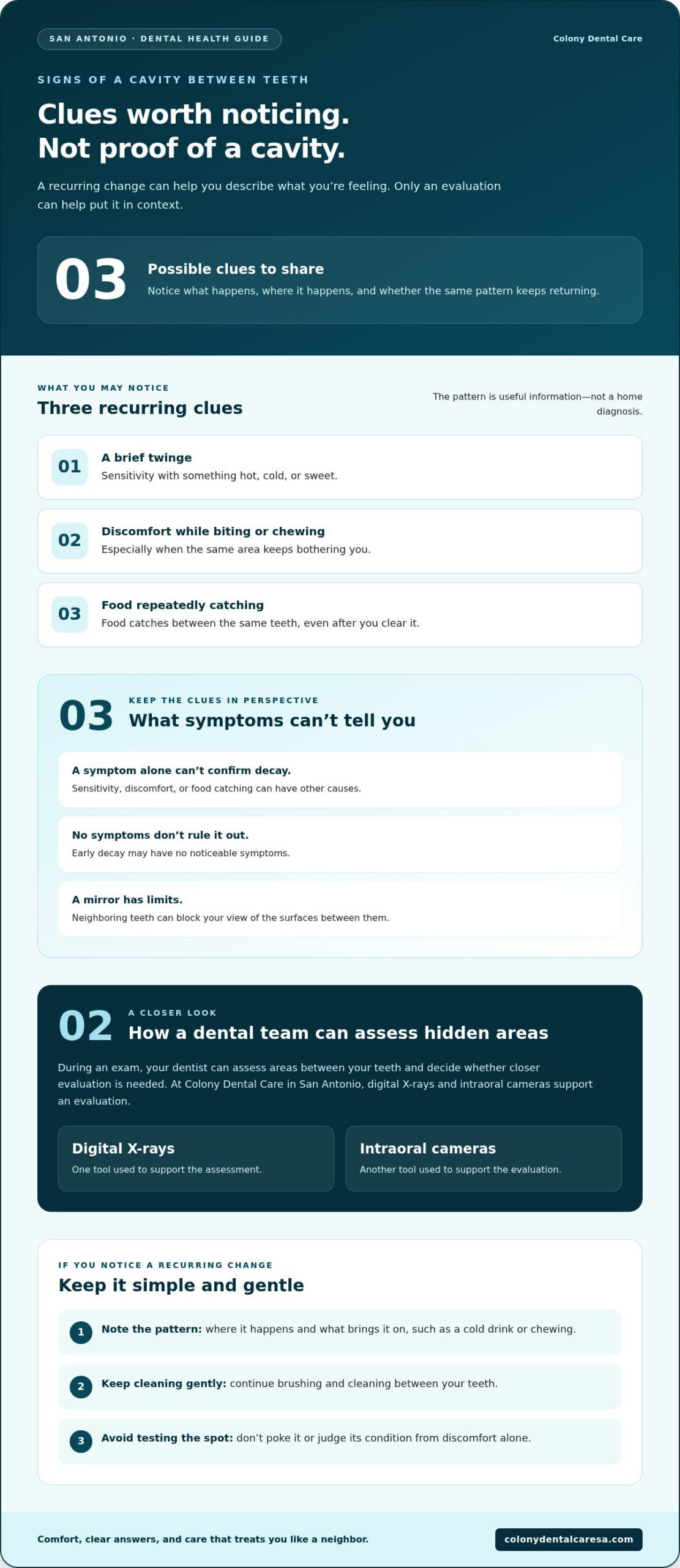
When decay affects a surface between teeth, you may notice a response during everyday activities. The feeling can come and go, and it may be difficult to pinpoint the tooth involved. Possible clues include:
- A brief twinge with hot or cold food and drinks, or something sweet.
- Discomfort when you bite or chew, especially if it keeps happening in the same area.
- Food that repeatedly catches between the same teeth, even after you clear it.
One episode doesn’t prove there’s decay. Notice whether the same trigger or spot keeps bothering you, and describe that pattern at a dental visit. Food trapping can also relate to the shape or spacing of teeth, so treat it as a clue to have assessed, not proof of a cavity.
Can you have a cavity without seeing or feeling it?
Yes. Neighboring teeth can sit close together, making their side surfaces difficult to see in a mirror. You may be able to inspect the chewing surfaces and fronts of your teeth but still not see the contact area clearly. A home mirror check has limits, even when you look carefully.
Early decay may have no noticeable symptoms.
You may not feel pain or see a dark spot, even if an area needs attention. No symptoms can’t rule out decay, just as sensitivity alone can’t establish that a cavity is present. A dentist can assess the areas between your teeth during an exam and decide whether closer evaluation is needed. Dental caries describes the decay process, but a general overview can’t determine what is happening in your mouth.
If you notice a recurring change, make a brief note of where it happens and what brings it on, such as a cold drink or chewing. Keep brushing and cleaning between your teeth gently. Don’t poke the area or try to judge its condition from discomfort alone. In San Antonio, a dental exam can help you get clear, personalized guidance. Your observation matters, but an examination helps put it in context.
Why cavities form between teeth, and why they can stay hidden
An interproximal cavity is decay on the side surface between two neighboring teeth. Because these surfaces sit close together, they can be harder to clean and see than the broad chewing surfaces. The hidden location may explain why you don’t spot a change at home, but it doesn’t confirm that decay is present.
How plaque can contribute to decay between teeth
Plaque is a soft film that forms on teeth. It can build up around the places where neighboring teeth meet, especially if cleaning doesn’t reach those surfaces regularly. Bacteria in plaque can contribute to decay by acting on sugars left in the mouth. Frequent sugary snacks or drinks may increase cavity risk, but they don’t mean a cavity will definitely form.
Daily brushing and cleaning between your teeth help remove plaque from places a toothbrush may not reach well on its own. Gentle, consistent care is more useful than trying to scrub one tight spot aggressively. The Harvard University site offers general educational resources; your dentist can help apply dental information to your teeth and concerns.
Why a mirror may not reveal the problem
The contact area between teeth may be blocked from direct view, even when the visible parts of both teeth look normal. A photo or mirror check can’t reliably show what’s happening on a covered surface. Avoid poking between teeth to test for a cavity. That can’t confirm decay and may irritate the area.
It helps to know the basic tooth layers. Enamel is the hard outer covering. Beneath it is dentin, a softer layer that surrounds the inner part of the tooth. Decay can affect these layers, but its course varies. There’s no dependable timeline for predicting what is happening based on appearance or sensation alone.
This is why the signs of a cavity between teeth are clues to discuss, not a home diagnosis. A tooth can seem unchanged while a less visible surface needs evaluation. A hidden spot isn’t automatically a cavity, either. A dental professional can assess the area and explain what they find, so you know whether any next step is needed.
Keep up your usual gentle brushing and cleaning between teeth, and mention recurring concerns at a dental visit. If you’re in San Antonio and want a professional assessment, learn about dental exams and cleanings at Colony Dental Care.
Do these symptoms always mean you have a cavity?
No. Sensitivity, discomfort when biting, or food catching can be reasons to pay attention, but none proves that decay is present. Symptoms can overlap with other dental concerns and don’t always point to the exact tooth or spot causing them. An exam can help determine whether decay or another issue needs attention.
Sensitivity, pain, and food catching: what they can and cannot tell you
A brief twinge with a cold drink, soreness while chewing, or food that often catches in one area can help you describe what you’re experiencing. These clues are more useful as a recurring pattern than as a do-it-yourself test for a cavity between teeth. Note when the feeling occurs, which side or area is involved, and whether it keeps returning.
There can be more than one explanation for sensitivity or discomfort when biting. A tooth, the surrounding gum, or another area of your mouth may be involved, so a symptom alone can’t identify the cause. Bleeding gums or persistent bad breath also don’t, by themselves, establish that you have tooth decay. Share these changes with your dentist, especially if they persist or concern you.
Don’t try to provoke a reaction. Avoid pressing on a tooth, poking between teeth with a sharp object, or using very hot or cold food and drinks to see what hurts. These tests can cause discomfort without giving you a reliable answer. Instead, describe what you noticed during ordinary eating, drinking, brushing, or cleaning between your teeth.
Why a dental assessment matters
A dentist can examine your mouth and assess areas you can’t see clearly at home. Your symptoms and the exam findings help determine whether further assessment is needed. The approach depends on your needs; not every visit calls for the same steps or leads to the same recommendation.
An exam helps separate a symptom from its cause. If you report a twinge with cold drinks, for example, the dentist can consider that detail alongside the location and exam findings, rather than treating sensitivity as automatic proof of a cavity. Your description is useful, but it’s only one part of the assessment.
The signs of a cavity between teeth can overlap with other concerns, so a professional evaluation is a clear way to understand what’s happening. You don’t need to arrive with a diagnosis. Bring your observations and questions, and your dental team can explain the findings and possible next steps in plain language. Colony Dental Care in San Antonio provides dental exams in a calm, comfortable setting.
What to do if you notice signs of a cavity between teeth
If you notice a recurring change, take a calm, practical approach. You don’t have to decide whether it’s a cavity before seeking help. A dental evaluation can clarify what’s going on, while gentle home care supports your mouth in the meantime. Mild symptoms, or no symptoms at all, aren’t a reliable reason to dismiss a concern.
- Notice the pattern. Pay attention to which area seems affected and whether the concern returns during eating, drinking, or cleaning your teeth.
- Keep cleaning gently. Continue brushing and cleaning between your teeth as part of your usual routine. Don’t scrape, poke, or scrub a spot to try to remove decay.
- Arrange a dental evaluation. A dentist can examine the area and help determine whether it needs attention.
Home care helps maintain oral health, but it can’t remove an established cavity. If decay is present, a dental professional can explain the findings and discuss an appropriate next step. Getting an assessment doesn’t mean you’ve confirmed a cavity or committed to a particular treatment. It gives you clearer information than a mirror check can provide.
How to prepare for an appointment
A few simple notes can help you explain your concern. Write down when you first noticed the change, what seems to trigger it, and whether it happens in the same area. Mention recurring food trapping or a change in sensitivity, even if the feeling comes and goes. These details help your dentist understand your experience, but they don’t determine a diagnosis or treatment in advance.
What habits can help protect the spaces between teeth?
Brush consistently and clean between your teeth as part of your regular oral care. Be gentle, especially around a spot that feels tender. Keep up with regular dental visits so you can discuss concerns and get guidance suited to your needs. For more information, read our guide, “Dental Cleaning in San Antonio: What to Expect,” and learn more about the practice in “Your Dentist in San Antonio, TX: A Guide to Our Care.”
Colony Dental Care provides dental exams in San Antonio to help you understand a tooth concern. You can learn more about the visit and arrange an assessment through our dental exam page.
How Colony Dental Care evaluates a possible cavity in San Antonio
If you’re concerned about a tooth, an exam can help replace guesswork with a clearer understanding of what may be happening. Colony Dental Care’s Dental Exams & Cleanings give you an opportunity to discuss your concern and have the area assessed. Share what you’ve noticed, even if it’s mild or has come and gone. Our goal is to understand your needs and explain the findings clearly and comfortably.
What to expect during an evaluation
Your dental team will consider your concern and examine the affected area. Colony Dental Care uses digital X-rays and intraoral cameras to help assess dental concerns. Digital X-rays may help the dentist evaluate areas that are difficult to see directly, including surfaces between teeth. The tools used depend on your needs. Not every visit requires X-rays, and a specific treatment can’t be assumed before the evaluation.
An exam helps distinguish decay from other possible causes of a tooth concern. Your observations are part of the picture, and the dentist can explain what the assessment shows and whether anything needs attention. If treatment is appropriate, Composite Dental Fillings are among the restorative services available at Colony Dental Care. The next step depends on what the dentist finds, so you can ask questions and understand the recommendation before moving forward.
Comfort-focused dental care in the San Antonio community
Colony Dental Care has provided more than 30 years of trusted care in San Antonio. Uncertainty about a tooth can feel stressful, so we aim to make your visit calm, respectful, and focused on you. Your concern deserves thoughtful attention, whether it involves decay or something else. You can discuss what the team finds and ask questions about possible next steps.
The signs of a cavity between teeth can raise questions, but an in-person assessment helps clarify the cause. Colony Dental Care welcomes you to schedule a dental exam if you’ve noticed a change and would feel more at ease having it checked. Our team is here to help you feel heard and understand your options.
Take the Next Step With Confidence
You don’t need every answer before you talk about a tooth concern. Your observations, even a small change in how a tooth feels, are a useful starting point. You can ask questions and understand what the evaluation shows before deciding on any next step.
If you’ve noticed the signs of a cavity between teeth, remember that a symptom is a reason to pay attention, not a verdict. The cause may be something other than decay, and a professional assessment can help clarify what’s going on. Clear information can help you feel prepared to make decisions about your oral health.
Keep caring for your smile with patience and consistency. For a dental exam in San Antonio, schedule an appointment with Colony Dental Care and get clear, personalized guidance about your concern.
Frequently Asked Questions
Can a cavity between teeth go away on its own?
An established cavity doesn’t disappear with brushing or flossing. Very early changes to enamel may sometimes be managed before a hole forms, but a dental professional needs to assess the tooth to determine what’s happening. Keep up gentle daily cleaning and arrange an evaluation if you’re concerned. Even if a twinge settles down, that change alone can’t tell you whether the tooth is healthy.
Can a cavity between teeth cause bad breath?
It can be one possible factor, but bad breath has several causes and doesn’t confirm a cavity. Food caught between teeth or other oral health concerns may contribute to an unpleasant smell. Notice whether it continues after your usual brushing and cleaning routine, and whether you’ve also noticed gum changes. If the odor persists, share those details with your dentist so the cause can be assessed.
Does flossing remove a cavity between teeth?
No. Flossing cleans the spaces between teeth, but it can’t repair tooth damage caused by decay. Guide floss gently along the side of each tooth instead of snapping it down into the gums. If a spot is painful or floss won’t pass comfortably, don’t force it. Mention repeated catching or discomfort at a dental visit so the area can be checked.
Can you have a cavity between teeth without pain?
Yes. A cavity may not cause pain or another clear warning at first, so feeling fine doesn’t rule out decay. For most patients, dental visits are recommended every six months, though your dentist can advise you based on your needs. If you notice a new change between visits, such as sensitivity in one area, you can arrange an evaluation instead of waiting for your next routine appointment.
What does a cavity between teeth look like?
You may not be able to see one because the affected surfaces face each other. A dark mark or other visible change can have different explanations, so appearance alone can’t confirm decay. Avoid trying to inspect the contact area with a sharp object or relying on a phone photo. Your dentist can examine the teeth and explain whether the appearance needs further assessment.
Is sensitivity to cold always a sign of a cavity?
No. Cold sensitivity can have causes other than decay, so it doesn’t identify a cavity on its own. If it happens, note which area reacts and whether the feeling starts during a cold drink or at another time. That context can help your dentist assess the concern. If sensitivity keeps returning or worries you, arrange an exam rather than testing the tooth with extreme temperatures.
How can a dentist find decay between teeth?
A dentist examines your teeth and considers your symptoms to assess surfaces that aren’t easy to see directly. Depending on what the exam shows, the dentist may recommend additional evaluation. The approach depends on your needs, so the same steps aren’t required for everyone. Tell the dental team where you feel discomfort, when it occurs, and whether food repeatedly gets trapped. This gives them useful context for the assessment.