What if that tiny “soft spot” your dentist mentioned wasn’t an automatic sentence for a dental drill? Many of our neighbors ask us, can a cavity be reversed, and the answer is often more hopeful than you might think. We understand that the moment you notice a bit of sensitivity, your mind might jump straight to the sound of a drill or the worry of an unexpected expense. It’s completely natural to feel some anxiety, especially when the CDC reports that 1 in 5 adults currently has at least one untreated cavity. You deserve clear, honest answers that cut through the noise of conflicting online advice.
We want you to know that you’re not alone, and your dental health is a partnership we value deeply. In this guide, we’ll help you discover the critical difference between early tooth decay and a permanent cavity, and learn exactly how you can stop or even reverse the process before a filling is needed. We’ll walk through the clear criteria for reversibility and provide actionable steps you can take today to strengthen your enamel. Whether we can heal the tooth naturally or eventually need a gentle, modern restoration, we’ll ensure your experience is comfortable and focused entirely on your peace of mind.
Key Takeaways
- Understand the vital difference between early decay and a permanent hole to see exactly how can a cavity be reversed through the natural process of remineralization.
- Learn how to use saliva and fluoride treatments as a protective shield that repairs your enamel and strengthens your teeth against future sensitivity.
- Spot the early “white spot” signs of decay so you can take action quickly while your tooth is still capable of healing itself without a drill.
- Adopt simple daily habits, like the “Snack Attack” rule, to limit acid exposure and create the ideal environment for your smile to thrive.
- Find peace of mind knowing that modern tooth-colored fillings offer a comfortable, gentle solution for restoring your health if decay has progressed.
What Does It Mean to “Reverse” a Cavity?
You might have heard conflicting stories about whether can a cavity be reversed. It’s a common question we hear from our neighbors, and the answer lies in understanding that tooth decay is a process, not just a single event. When we talk about “reversing” decay, we’re really talking about intervening before a permanent physical hole forms in your tooth. A cavity is the actual damage left behind after a long period of mineral loss; it’s the destination at the end of the decay journey.
Think of your enamel as a sturdy wall made of minerals like calcium and phosphate. Throughout the day, this wall faces constant wear and tear from the foods we enjoy. If we catch the damage early, we can help your body reinforce those weak spots. We look at The Science of How Teeth Heal Themselves to understand how our mouths are designed for constant, quiet repair. Our goal is to support your body’s natural defenses so you can avoid the need for more complex work later on. We believe in a partnership where we provide the expertise and you have the tools to protect your smile at home.
The Demineralization vs. Remineralization Cycle
Every time you eat sugary or starchy snacks, bacteria in your mouth produce acids. These acids act like a solvent, stripping away the vital minerals that keep your teeth strong. This stage is known as demineralization. It sounds a bit scary, but it happens to everyone. Thankfully, your saliva acts as a natural, mineral-rich bath that flows over your teeth to neutralize those acids and replace what was lost. Remineralization is the biological process of restoring minerals to the enamel matrix. As long as this repair process keeps up with the damage, your tooth stays healthy and intact.
Can You “Regrow” a Hole in Your Tooth?
There is a lot of advice online suggesting you can heal deep cavities with special diets or oils. We want to be honest and gentle with you. Once decay creates a physical hole in your enamel, your tooth cannot regrow that lost structure. Enamel is the hardest substance in your body, but it doesn’t contain living cells. This means it can’t heal itself like a cut on your finger or a broken bone. The key is to catch decay while it is still just a “soft spot.” If you’ve wondered if can a cavity be reversed, the answer is a hopeful “yes,” provided we act while the enamel is still structurally whole. We’re here to help you identify those early signs so we can keep your smile strong, healthy, and natural.
The Science of How Teeth Heal Themselves
Your mouth is a vibrant, living ecosystem that works around the clock to keep your smile healthy. Every time you enjoy a meal or a snack, a silent chemical tug-of-war begins. On one side, bacterial acids try to pull minerals away from your teeth. On the other, your body uses its own natural resources to push those minerals back into place. Whether can a cavity be reversed often depends on which side is winning this daily battle. If your mouth stays in an acidic state for too long, the enamel begins to break down. However, when the pH balance is restored quickly, your teeth have the opportunity to heal themselves naturally.
The Role of Fluoride and Minerals
Fluoride is a key player in this recovery process. It acts as a powerful catalyst, drawing calcium and phosphate ions back into your enamel more efficiently than your body can do alone. When these minerals recombine in the presence of fluoride, they create a new surface called fluorapatite. This layer is actually more resistant to acid than your original tooth structure. We often recommend fluoride treatments during routine visits because they provide an extra boost of protection that helps you stay on the winning side of the mineral tug-of-war.
We know some patients have questions about fluoride safety. We want to reassure you that when used correctly, fluoride is a safe and incredibly effective tool for preventing restorative work. It’s a naturally occurring mineral that has been a cornerstone of dental health for decades. By strengthening the enamel matrix, it helps you avoid the discomfort and cost of more invasive procedures. It’s all about providing your teeth with the right environment to thrive.
Saliva: Your Mouth’s Natural Defense System
Saliva is your mouth’s primary defense and repair fluid. It does much more than just help you swallow; it’s a complex mixture that neutralizes acids and bathes your teeth in the minerals they need to stay strong. If you experience dry mouth, also known as xerostomia, your teeth lose this essential mineral bath, which can accelerate decay. This lack of moisture makes it much harder for your body to repair early damage before it reaches the point of no return where a physical cavity forms.
If you struggle with dry mouth, there are practical steps you can take to protect your smile. You can support your salivary flow by staying hydrated throughout the day and chewing sugar-free gum after meals. These small habits encourage your mouth to produce the fluid needed to wash away debris and restore balance. Understanding that can a cavity be reversed gives you the power to take control of your oral health through simple, daily care that prioritizes your comfort and long-term wellness.
Identifying the Point of No Return: Is Your Cavity Reversible?
Knowing exactly where you stand in the decay process is the best way to find peace of mind. We often see patients who worry that every bit of sensitivity means a drill is in their future. However, the answer to whether can a cavity be reversed depends entirely on the current stage of the enamel. Think of it as a sliding scale; on one end, you have healthy teeth, and on the other, a physical hole. In between lies a window of opportunity where we can help you turn things around.
Your nerves often act as the first alarm system. Mild, fleeting sensitivity to cold might just be a sign of thinning enamel or a “soft spot” that we can still save. If you experience sharp pain or lingering sensitivity to sweets, the decay may have reached the dentin, which is the layer beneath your enamel. At this point, the goal shifts from reversal to a gentle, protective restoration. We also use digital X-rays to see what’s happening between your teeth, catching tiny issues long before they become visible to the naked eye or cause you any discomfort.
The Visual Guide to Early Decay
If you look closely in a well-lit mirror, you might spot a “white spot lesion.” This looks like a chalky, opaque patch on the tooth’s surface. This is the hallmark of demineralization and represents your final chance for non-invasive reversal. These spots are much easier to manage on the smooth sides of your teeth. If the decay is hidden in the deep pits and fissures of your molars, it can be trickier to reach with minerals alone. If you notice these changes, it’s a great time to schedule a professional exam at Colony Dental Care so we can create a personalized plan for you.
Signs You Need a Restorative Filling
Once a white spot transitions to a brown or black color, the structural integrity of the enamel has usually been compromised. At this stage, the answer to can a cavity be reversed is likely no, but don’t let that discourage you. Modern dentistry is incredibly gentle, and catching a cavity now prevents much bigger problems later. Watch for these specific signs that a filling might be necessary:
- Sticky spots: During an exam, a dental explorer might “catch” on a softened area of the tooth.
- Lingering sensitivity: Discomfort that lasts for several seconds after you’ve finished a cold drink or a sugary treat.
- Food traps: Noticing that floss or food particles consistently get stuck in the same spot between teeth.
- Visible shadowing: A dark area beneath the enamel surface that suggests a hole is forming underneath.
Managing your diet is also a huge part of this process. The World Health Organization provides Practical Steps to Reverse Early Decay by highlighting how reducing sugar intake stops the acid attacks that lead to permanent damage. By combining dietary changes with professional care, we can protect your smile and keep you feeling your best.
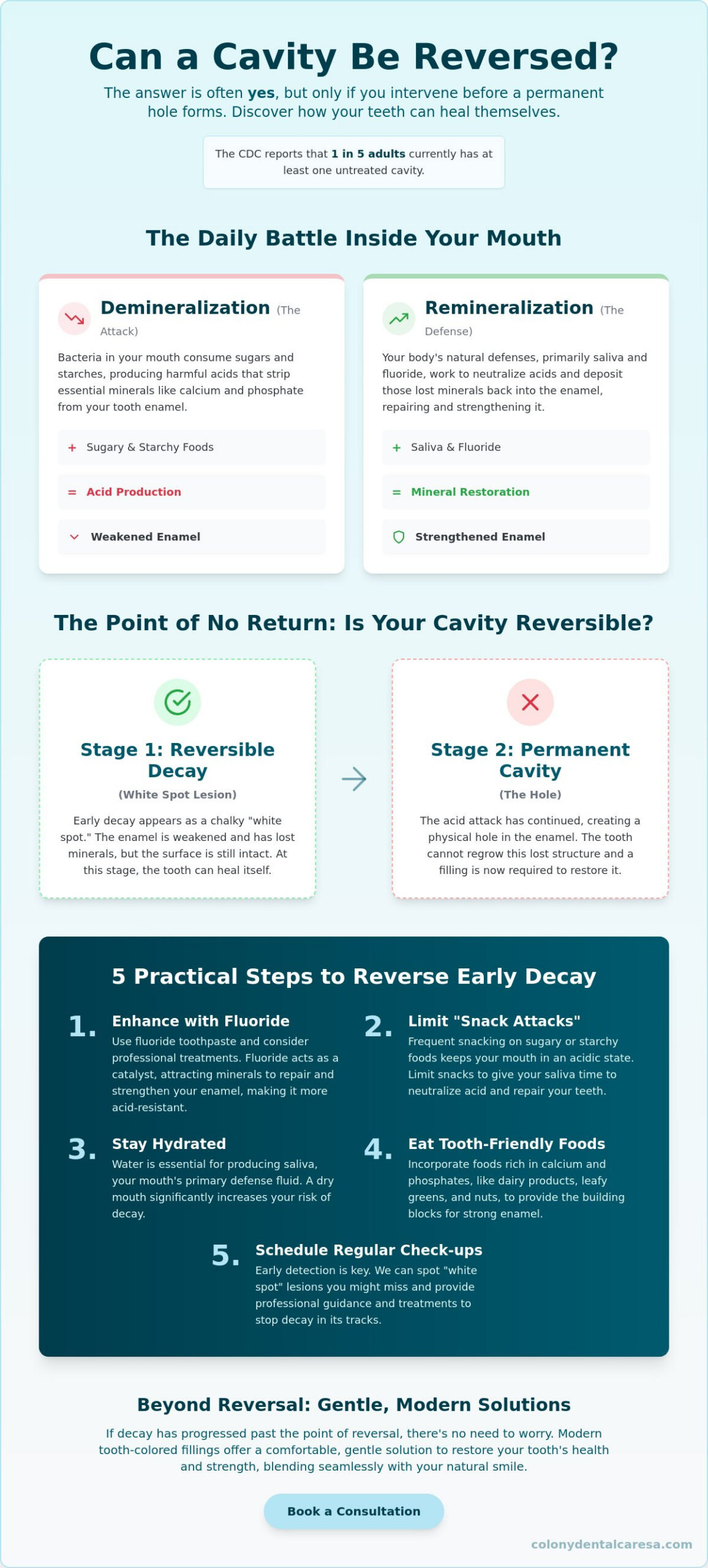
5 Practical Steps to Reverse Early Decay at Home
You have more power over your oral health than you might think. While we are always here to guide you, the daily work of protecting your smile happens in your own home. If you’ve been wondering if can a cavity be reversed, these five steps provide a clear roadmap to help you strengthen your enamel and stop decay in its tracks. By creating a mineral-rich environment, you give your teeth the best possible chance to heal naturally.
Consistency is your greatest ally. We recommend optimizing your hygiene routine with high-fluoride products, which act as a concentrated “vitamin” for your enamel. Alongside this, we suggest adopting the “Snack Attack” rule. Every time you eat, your mouth becomes acidic for about 20 minutes. By reducing the frequency of snacking and sticking to set mealtimes, you limit the number of acid attacks your teeth must endure. Staying hydrated is also vital. Drinking plenty of water throughout the day keeps your saliva flowing, which we’ve already identified as your body’s primary repair fluid. You might also consider using products containing Xylitol. This natural sweetener actually disrupts harmful bacterial colonies, making it harder for them to stick to your teeth and produce acid.
Dietary Changes for Stronger Enamel
What you eat is just as important as how often you eat. To give your enamel a fighting chance, try cutting back on fermentable carbohydrates and “sticky” sugars like dried fruits or gummy candies that cling to the surfaces of your teeth. Instead, focus on foods that promote remineralization. Cheese, leafy greens, and lean proteins are excellent choices because they provide the calcium and phosphate your body needs to rebuild tooth structure. One of the biggest hurdles to healing is the habit of sipping on soda or sweetened coffee all day. Even diet soda is highly acidic. This constant exposure prevents your mouth’s pH from ever returning to a neutral, healing state.
Advanced Home Care Tools
The tools you use can make a significant difference in your results. We often suggest electric toothbrushes because they offer superior plaque removal compared to manual brushing. However, you can’t answer the question of can a cavity be reversed successfully if you don’t clean between your teeth. Decay often starts in these hidden gaps where a toothbrush can’t reach. Using interdental brushes or floss daily is non-negotiable for reversing early lesions. We also have a local advantage here. Utilizing San Antonio’s fluoridated water for drinking and rinsing provides a steady, gentle dose of minerals that protects your family’s smiles every day.
If you’re ready to take the next step in your health journey, we invite you to schedule a professional fluoride treatment to give your enamel the ultimate boost.
Beyond Reversal: Comfortable Solutions at Colony Dental Care
We’ve explored the fascinating science of remineralization and the many ways your body works to protect itself. It’s an amazing process. But we also want to be realistic and supportive. Sometimes, despite your best efforts at home, decay reaches a stage where the answer to can a cavity be reversed is “no.” If you find yourself at this point, please don’t feel discouraged. This isn’t a failure on your part. It’s simply a signal that your tooth needs a little extra help to stay strong and healthy for years to come.
At Colony Dental Care, we specialize in “Gentle Dentistry.” We know that many of our neighbors feel anxious about the sound of a drill or the potential cost of restorative work. We prioritize your peace of mind above all else. Choosing a small, tooth-colored filling today is a proactive, compassionate choice for your future self. It seals out harmful bacteria and prevents the decay from spreading deeper into the tooth. By acting early, you often avoid the need for more complex and expensive treatments, such as root canal therapy or tooth extractions, down the road.
Professional Preventive Treatments
We provide several “boosters” designed to keep your enamel in the reversible stage for as long as possible. Dental sealants are a wonderful example. These are thin, protective coatings we apply to the deep grooves of your molars. They act as a sturdy physical barrier, keeping food and bacteria from settling in those hard-to-reach places. During your routine cleaning, we can also apply a professional-grade fluoride varnish. This treatment is much more potent than over-the-counter options. It gives your teeth a concentrated mineral bath that encourages the natural healing process we’ve discussed. Regular exams are the best way for us to catch these issues early while they are still manageable, and you can learn more about Caroline Springs Dental Clinic to see how they prioritize these preventive strategies for their patients.
A Reassuring Approach to Fillings
Dr. Oei takes a personalized, unhurried approach with every San Antonio family we serve. We want you to feel seen and heard as an individual. Our goal is to create a total health partnership that lasts for years. If we do find that a filling is necessary, we use modern, tooth-colored composite resins. These materials are incredibly durable and blend seamlessly with your natural smile. They look and feel just like your original tooth. Most importantly, we ensure the entire experience is easy, quiet, and stress-free. We’re here to guide you every step of the way with kindness and expertise.
Ready to find out where you stand? Schedule a gentle exam at Colony Dental Care to see if your tooth can be saved without a drill.
Take Control of Your Smile Today
Your journey toward a healthier smile doesn’t have to be filled with worry. We’ve seen how the question of can a cavity be reversed depends on acting quickly while your enamel still has its natural structure. By supporting your mouth’s mineral cycle with smart dietary choices and professional fluoride treatments, you can often stop decay before it ever requires a drill. Even if you’ve moved past the stage of natural repair, modern restorative care is designed to be a quiet, comfortable experience that protects your long-term wellness.
With over 30 years of experience, Dr. James David Oei provides the warm, neighborly care you deserve. We prioritize your comfort and offer an in-house dental membership for those without insurance to ensure quality care remains accessible. We invite you to Book Your Reassuring Dental Exam in San Antonio Today and let us help you find the best path forward for your health. You don’t have to navigate these choices alone; we’re here to partner with you every step of the way.
Frequently Asked Questions
How long does it take to reverse a soft spot on a tooth?
It generally takes several months of consistent care to remineralize a soft spot on your tooth. This timeline depends on your daily hygiene habits, your diet, and the regular use of professional fluoride treatments. Because enamel repairs itself slowly, we monitor these areas during your routine exams to ensure the “white spot” is hardening and becoming more acid-resistant over time.
Is it possible to heal a cavity naturally with coconut oil pulling?
No, coconut oil pulling cannot heal a physical cavity or replace lost tooth structure once a hole has formed. While oil pulling may reduce some surface bacteria, it lacks the essential minerals like fluoride, calcium, and phosphate required for remineralization. To truly see if can a cavity be reversed, you need clinically proven methods that actively rebuild the enamel matrix and protect your tooth’s integrity.
Can a dentist tell the difference between a reversible white spot and a permanent cavity?
Yes, we use specialized tools and visual exams to accurately distinguish between the two stages of decay. A reversible white spot is typically smooth and hard, whereas a permanent cavity feels “sticky” or soft when we use a dental explorer. We also use digital X-rays to see if the decay has breached the enamel and entered the dentin, which confirms that a restorative filling is necessary.
Do certain vitamins help in reversing tooth decay?
Vitamins D and K2 play a supporting role in how your body processes calcium, which is vital for tooth health. While vitamins alone won’t fix a “soft spot,” they help ensure your saliva has the right mineral balance to support remineralization. We view nutrition as a foundational part of your overall systemic well-being and a partner to your daily brushing and flossing routine.
What happens if I ignore a small, reversible cavity?
Ignoring early decay allows the demineralization process to continue until a permanent hole forms in the enamel. Once the decay breaks through this outer layer, it spreads much faster through the softer dentin toward the nerve. What could have been reversed with simple fluoride treatments may eventually require a tooth-colored filling, a root canal, or even an extraction if the damage becomes too extensive.
Are there any specific foods I should avoid to help my teeth remineralize?
You should avoid frequent snacking on fermentable carbohydrates and acidic drinks like soda or citrus juices. These foods lower the pH in your mouth, creating an environment where minerals are stripped away faster than they can be replaced. By limiting these “acid attacks,” you give your saliva the time it needs to bathe your teeth in protective minerals and support the natural healing process.
Is reversing tooth decay harder for adults than for children?
The biological process of remineralization is the same for everyone, but adults often face unique challenges like dry mouth or receding gums. Children’s teeth are often very responsive to fluoride treatments because the enamel is still maturing. However, adults can absolutely achieve success by staying hydrated and maintaining a meticulous hygiene routine. It is never too late to prioritize your comfort and strengthen your smile.
Does San Antonio’s tap water help in reversing early decay?
Yes, San Antonio’s fluoridated tap water provides a constant, low-level dose of fluoride that is very beneficial for our community. Every time you drink or rinse, you’re delivering a small amount of this mineral to your enamel. This local advantage helps many of our neighbors stay in the “reversible” stage of decay and often reduces the need for more invasive restorative work over time.